Introduction
Managing IT in-house has become genuinely difficult. Cyber threats are up, cloud environments are more complex than ever, and around one-third of outages now cost more than $250,000 — with many exceeding $1 million. For most businesses, that's not a risk worth carrying alone.
The right managed IT service provider (MSP) shifts your operation from reactive firefighting to consistent, proactive infrastructure management. The provider you choose determines whether that shift actually happens — the wrong contract locks you into underdelivered promises, while the right one frees your team to focus on the work that matters.
This guide profiles five top managed IT service providers, covering what each does best, who they're built for, and how to evaluate them against your situation.
Key Takeaways
- MSPs handle 24/7 monitoring, cybersecurity, cloud management, and help desk support so your team can focus on the business
- Top providers combine Microsoft and Cisco certifications, proactive support, and transparent pricing
- The right fit depends on response time, service breadth, compliance experience, and local availability
- Phoenix Metro businesses: InVision Technology Solutions brings 20 years of local experience, Microsoft and Cisco certifications, and a 5-minute average response time
- This guide profiles five providers with clear service details to help you compare
What Are Managed IT Services?
Managed IT services replace the old "break-fix" model — where you called someone after something broke — with a subscription-based relationship. Your MSP proactively monitors and manages your networks, endpoints, cloud systems, cybersecurity, and help desk support before minor issues become costly outages.
The market reflects how broadly businesses have adopted this model. Mordor Intelligence puts the global managed services market at $430.56 billion in 2026, growing at a 10.34% CAGR to reach $704.2 billion by 2031. Several converging forces are fueling that expansion:
- Rising cyber threats that outpace what internal teams can manage alone
- Accelerating cloud adoption requiring specialized configuration and oversight
- Persistent IT talent shortages that make building fully in-house teams expensive and difficult
Top Managed IT Service Providers
These five providers were selected based on service breadth, certifications, industry reputation, support responsiveness, and suitability for businesses of different sizes and sectors.
InVision Technology Solutions
Founded in 2006 and headquartered in Scottsdale, AZ, InVision Technology Solutions has spent nearly 20 years serving small, mid-size, and large businesses across the Phoenix Metro area. Their industry depth spans healthcare, legal, dental, finance, and manufacturing — sectors where compliance and uptime aren't optional.
What separates InVision operationally is the structure behind every client engagement. Each client gets two dedicated engineers assigned to their account — a primary and secondary admin — plus a technical manager and account manager.
The company's InWatch monitoring system runs 24/7 across servers, desktops, laptops, and network devices. Contractually, InVision guarantees a 1-hour response time; in practice, the average is 5 minutes.
Their Microsoft Silver Technology Partner and Select Certified Cisco Partner credentials back the technical depth. And unlike many MSPs, InVision requires no long-term service commitment, which signals real confidence in their delivery.
| Category | Details |
|---|---|
| Key Services | Managed IT, network monitoring, cybersecurity, VoIP, Microsoft 365 management, cloud solutions, help desk support |
| Best For | Small to large businesses in Phoenix Metro across healthcare, legal, dental, finance, and manufacturing |
| Notable Differentiators | 5-minute average response time, dedicated two-engineer model per client, no long-term commitment required, local Scottsdale-based team |

Dataprise
Dataprise is a nationally recognized MSP serving small and mid-sized enterprises with both fully managed and co-managed IT options. Their consultant network spans 30+ major markets, backed by 24/7 support and advanced SLAs.
The co-managed model is where Dataprise stands out. Businesses that have internal IT staff — but need deeper security coverage or supplemental bandwidth — can add Dataprise without replacing their existing team. They've earned CRN MSP 500 Elite 150 recognition, reflecting consistent performance at scale.
| Category | Details |
|---|---|
| Key Services | Managed IT, co-managed IT, cybersecurity, cloud services, IT strategy and consulting |
| Best For | Mid-sized businesses with internal IT teams looking for security augmentation and expanded support |
| Notable Differentiators | Established national presence, flexible co-managed IT model, advanced cybersecurity suite |
Ntiva
Ntiva is a U.S.-based MSP focused on scalable managed IT for fast-growing small and mid-sized businesses. Their full-service model includes 24/7 help desk, cloud management, cybersecurity, and a dedicated virtual CIO (vCIO) program.
The vCIO offering is Ntiva's clearest differentiator. Rather than just keeping systems running, they provide strategic IT roadmapping — making them a strong fit for companies that anticipate significant technology changes over the next one to three years. If your business is scaling quickly, Ntiva's advisory model can help you get ahead of infrastructure decisions instead of reacting to them.
| Category | Details |
|---|---|
| Key Services | Managed IT, cloud management, cybersecurity, 24/7 help desk, vCIO consulting |
| Best For | Fast-growing SMBs that need an IT partner capable of scaling services alongside business expansion |
| Notable Differentiators | Flexible service model, strong vCIO advisory capabilities, long-term strategic IT roadmapping |
Corsica Technologies
Corsica Technologies serves mid-market and enterprise clients with a fully integrated team spanning IT services, cybersecurity, cloud management, and data integration — all bundled under their flat-fee "Corsica Secure" plan.
Their most distinctive position in the market: cybersecurity isn't an add-on. It's built into the managed IT contract, handled by an internal team rather than outsourced. Corsica also publishes a Cybersecurity Service Guarantee that covers incident remediation — a level of accountability few providers offer in writing. For compliance-heavy industries, that guarantee carries real weight.
| Category | Details |
|---|---|
| Key Services | Managed IT, managed cybersecurity, cloud services, compliance management, EDI and data integration, vCISO consulting |
| Best For | Mid-market and enterprise businesses needing a single integrated team for IT and cybersecurity under one contract |
| Notable Differentiators | Cybersecurity service guarantee, all-inclusive flat pricing, integrated IT + cybersecurity + EDI model |
Rackspace Technology
Rackspace specializes in multi-cloud infrastructure management, supporting businesses operating across AWS, Microsoft Azure, and Google Cloud with advisory, migration, and ongoing operational services.
Their "Fanatical Experience" model provides high-touch expert support for complex cloud environments. Rackspace has also earned AWS Small and Medium Business Competency, meaning their reach extends beyond just large enterprises. That said, they're best suited for organizations with substantial cloud infrastructure already in place — businesses running lean on-premises environments may find the scope more than they need.
| Category | Details |
|---|---|
| Key Services | Multi-cloud management, cloud migration, application management, data modernization, managed security |
| Best For | Large enterprises with complex multi-cloud environments requiring deep technical expertise and ongoing cloud optimization |
| Notable Differentiators | Multi-cloud specialization across AWS, Azure, and GCP; large certified engineering team; global support coverage |
How to Choose the Right Managed IT Service Provider
Choosing an MSP on price alone is the fastest route to a bad contract. Businesses routinely sign with the lowest bidder, then find out six months later that response times aren't guaranteed, coverage has gaps, or onsite support isn't actually included. The five criteria below help you avoid that.
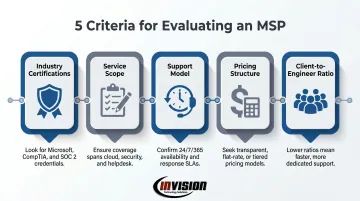
The Five Evaluation Criteria
Use this framework when comparing any MSP:
- Industry certifications: Microsoft and Cisco partnerships aren't just logos — they indicate access to vendor escalation paths, certified deployment capabilities, and required ongoing training. Ask to see the actual certification, not just the badge on a website.
- Service scope: Confirm whether network, security, cloud, and help desk are covered under a single contract. Stitching together multiple vendors creates accountability gaps when something breaks.
- Support model: Proactive monitoring (catching issues before they hit users) is worth more than fast reactive response. Either way, the response time guarantee should be written into the contract — not just mentioned in a sales call.
- Pricing structure: Flat monthly fees are far easier to budget than variable models where out-of-scope work triggers surprise invoices. Get the scope defined in writing.
- Client-to-engineer ratio and local presence: A lower ratio means engineers have more time for each account. If your business needs onsite support, verify the provider actually has staff nearby — not just a regional sales office.
Compliance Deserves Its Own Checklist
Standard IT management and compliance-aware IT management aren't interchangeable. A provider that's excellent for a general office environment may have zero experience with HIPAA audits or PCI DSS controls. Before signing, verify documented experience with your industry's requirements:
- Healthcare: HIPAA, HITECH, EMR/EHR system support
- Finance: SOX, PCI DSS, Gramm-Leach-Bliley Act
- Legal: Secure client data handling, case management software support
- Manufacturing: Operational technology security, EDI integration
CompTIA's Buying Guide for Managed Services recommends evaluating MSPs on capabilities, data protection, support SLAs, expertise and certifications, and contract terms — a five-point scorecard that holds up regardless of your industry.
Conclusion
Choosing a managed IT service provider is a long-term strategic decision. The right partner reduces downtime, strengthens security, and lets your leadership team focus on running the business rather than managing IT crises.
When evaluating options, look past brand recognition and monthly price. Ask for measurable commitments: guaranteed response time, uptime metrics, assigned engineers, and contract flexibility. Those specifics tell you more about a provider's actual service model than any marketing claim.
For businesses in the Phoenix Metro area, InVision Technology Solutions checks those boxes directly. With over 18 years of local experience, Microsoft Silver and Cisco Select Partner certifications, and a client model built on personalized support without long-term lock-in, they're worth a conversation. Reach them at 480-699-8077 or info@invisionaz.com to talk through your IT needs.
Frequently Asked Questions
How much do managed IT services cost?
Pricing typically follows a per-user or per-device monthly model, with costs varying based on service scope, business size, and support level. Flat-fee all-inclusive models offer the most predictable budgeting. Request itemized proposals from any provider so you can compare like-for-like scope, not just headline numbers.
What do managed IT services include?
Core components typically include 24/7 network monitoring, help desk support, cybersecurity (endpoint protection, threat detection, firewalls), cloud management, data backup and disaster recovery, patch management, and strategic IT consulting. Scope varies by provider and plan tier — always confirm what's included before signing.
Why do companies outsource IT support?
The main drivers are access to certified specialists without full-time hiring costs, predictable monthly budgets, faster incident response, and the ability to redirect internal teams toward core business operations. For SMBs especially, an MSP provides enterprise-grade capability at a fraction of the cost of building it in-house.
Which cloud platform is best for healthcare?
Both Microsoft Azure and AWS are widely adopted in healthcare, each offering HIPAA-compliant infrastructure, Business Associate Agreements, and defined eligible services for protected health information. The best choice depends on your existing Microsoft 365 environment and your MSP's certifications — a Microsoft-certified MSP is generally better positioned to manage Azure deployments for healthcare clients.
What does a healthcare IT technician do?
A healthcare IT technician manages EHR/EMR systems, HIPAA-compliant network configurations, device management, and data security specific to medical environments. An MSP experienced in healthcare handles these responsibilities proactively, with compliance built into the standard service model.