The problem isn't just downtime. Healthcare IT support costs vary widely depending on practice size, compliance requirements, service model, and system complexity—making it genuinely easy to build the wrong budget.
This guide covers typical pricing ranges, the factors that push costs up or down, what's actually included in most contracts, and how clinics, dental offices, and medical groups can budget accurately.
Key Takeaways
- Managed healthcare IT support typically runs $100–$250 per user/month depending on service tier; break-fix hourly rates run $175–$275/hour
- HIPAA compliance tools, 24/7 monitoring, and EHR-specific support are the primary cost drivers above standard IT pricing
- Small practices (3–5 users) pay more per user than larger groups—economies of scale don't apply at that size
- Managed service agreements deliver lower, more predictable costs than reactive break-fix—especially where downtime disrupts patient care
How Much Does Healthcare IT Support Cost?
There's no single fixed price. What you pay depends on which service model you choose, how many users and devices you have, and how much compliance and security support you actually need.
Two problems come up repeatedly with healthcare IT budgeting. Underbudgeting pushes practices toward break-fix support — one server failure or ransomware incident can quickly cost more than months of managed service fees. Overspecifying means paying for enterprise-grade capabilities a 4-person clinic will never actually use.
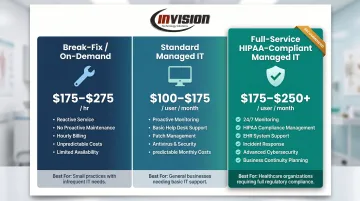
Typical Pricing Ranges by Service Model
| Service Model | Typical Range | Best For |
|---|---|---|
| Break-fix / on-demand | $175–$275/hour | Very small practices with minimal IT needs |
| Standard managed IT | $100–$175/user/month | Practices needing helpdesk + monitoring |
| Full-service HIPAA-compliant managed IT | $175–$250+/user/month | Any practice handling ePHI with compliance obligations |
Break-fix support carries no monthly commitment, but costs are completely unpredictable—one server failure or ransomware incident can generate a bill that dwarfs months of managed service fees.
Standard managed IT typically covers remote helpdesk, endpoint monitoring, patch management, and basic antivirus. It's a reasonable floor for low-risk environments, but most healthcare practices need more.
Full-service healthcare managed IT adds 24/7 network monitoring, HIPAA compliance support, cybersecurity tools, and EHR-specific helpdesk. This is where most medical practices should be operating.
What's Typically Included vs. Excluded
Understanding what base-tier packages actually cover — versus what they don't — is where most healthcare budget surprises originate.
Most base-tier managed IT packages cover:
- Remote helpdesk access
- Endpoint monitoring and patching
- Antivirus and basic malware protection
What they commonly exclude — and what healthcare practices almost always need:
- HIPAA risk assessments and audit log management
- After-hours emergency response
- EHR vendor liaison and application-specific support
- Hardware procurement and lifecycle management
- Security awareness training for staff
These items are priced as add-ons. Before signing any contract, ask your provider for a written breakdown of what's included at each tier — that conversation alone will reveal whether a quoted price is realistic for a regulated healthcare environment.
Key Factors That Drive Healthcare IT Support Costs
Healthcare IT pricing reflects regulatory, operational, and technical requirements that simply don't exist in other industries.
Practice Size and Number of Users
Per-user costs drop as practice size increases. A solo provider or 3-person clinic pays near the top of any pricing range. A 50-person multi-specialty group has negotiating leverage and spreads fixed infrastructure costs across more users.
The number of endpoints matters too. Every workstation, tablet, and networked medical device adds to monthly monitoring and management costs—practices with aging hardware or a high device-to-user ratio will see this reflected in their quotes.
HIPAA Compliance and Cybersecurity Requirements
HIPAA's technical safeguards—access controls, audit logging, encryption, breach notification procedures—require tools and processes that standard business IT doesn't. This isn't optional overhead.
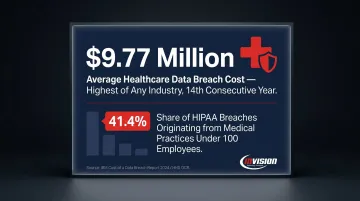
Healthcare data breaches averaged $9.77 million per incident in 2024, the highest of any industry for the 14th consecutive year. Small providers aren't exempt—practices with fewer than 100 employees accounted for 41.4% of all HIPAA breaches reported in 2024, with hacking and IT incidents responsible for 82.1% of those cases.
HIPAA-compliant IT support costs more because it has to include more: endpoint detection, email security, encrypted backups, risk assessments, and staff training.
EHR and Medical Software Integration
Supporting EHR platforms like eClinicalWorks, NextGen, AdvancedMD, or Medisoft requires experience that general-purpose IT providers often lack. EHR-related tickets—login failures, connectivity drops, update conflicts, and sync errors—rank among the most frequent support requests in any medical practice. An IT partner unfamiliar with your specific platform will take longer to resolve them and may introduce additional risk.
Practices running multiple systems (EHR + practice management + billing software + connected devices) should expect to pay a premium for providers with genuine healthcare IT depth.
That depth matters in practice. InVision Technology Solutions has supported Phoenix Metro medical practices—including Allergy Asthma Clinic, Ltd—for over a decade, covering platforms like eClinicalWorks, NextGen, AdvancedMD, and Medisoft. EHR support is built into their healthcare plans, not billed as a separate line item.
Support Hours and Response Time SLAs
Standard business-hours support costs less. 24/7 monitoring with guaranteed response times costs more—and for healthcare, the premium is usually worth it.
A practice whose EHR goes down at 7 AM can't wait until 9 AM for someone to answer the phone. Response time guarantees of 15 minutes or less for critical issues are worth paying for when patient care is on the line. InVision, for example, guarantees a 1-hour response time for managed clients but averages 5 minutes in practice.
Healthcare IT Support Cost Breakdown
Beyond the monthly fee, healthcare IT support has several distinct cost components worth understanding separately.
Helpdesk and Remote Support
This covers day-to-day issues: password resets, software errors, EHR access problems, and connectivity failures. It should be bundled into per-user monthly fees rather than billed separately. For medical practices, look for response time guarantees under 1 hour for standard tickets and 15 minutes or less for critical issues affecting patient care workflows.
Cybersecurity and HIPAA Compliance Tools
67% of healthcare organizations were hit by ransomware in 2024, with median recovery costs of $2.57 million — not counting ransom payments. That context explains why this cost category is non-negotiable.
Tools in this layer include endpoint protection, email security, security awareness training, audit log management, and risk assessments. Vendors often price these separately from base IT support, so confirm what's included before signing any agreement.
Network Monitoring and Infrastructure Management
24/7 monitoring of servers, routers, firewalls, and networked devices catches failures before they disrupt patient care — and reduces emergency callout costs over time. InVision's InWatch system, for example, monitors all endpoint and network devices around the clock, which is how the company maintains 99.9% system uptime for its healthcare clients.
On-Site Support and Hardware Services
Physical visits for hardware installation, device replacement, cabling, or complex troubleshooting are either billed hourly or included in higher-tier plans. Practices with aging hardware or multiple locations should budget for this line item — it's where the most common surprise expenses appear.
In-House IT vs. Managed IT Support for Healthcare Practices
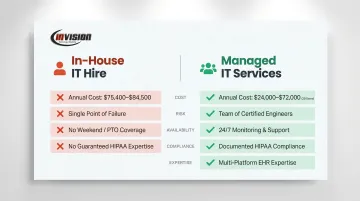
A single in-house IT hire at the BLS median salary of $60,340 runs approximately $75,400–$84,500 fully loaded once you factor in benefits, payroll taxes, and overhead—before equipment, training, or certifications. That's one person, with no coverage during PTO or illness, no backup for nights and weekends, and no guarantee of HIPAA expertise or EHR platform experience.
For comparison, a 20-user practice on a managed IT services plan at $100–$300/user/month spends $24,000–$72,000 annually—and gets a team with broader expertise, 24/7 monitoring, and documented compliance processes.
The managed IT services advantage for healthcare practices includes:
- Multiple certified engineers (no single point of failure)
- 24/7 monitoring that doesn't stop when someone calls in sick
- Documented HIPAA-compliant processes and audit-ready procedures
- Broader platform expertise across EHR systems, network security, and compliance tools
- Predictable monthly cost with no surprise benefit or turnover expenses
Hybrid models—an internal IT coordinator paired with MSP support—work well for larger practices with 100+ staff who need on-site presence daily. For most small-to-mid-sized medical groups, though, full outsourcing produces lower total cost with more consistent coverage and compliance documentation.
How to Build an Accurate Healthcare IT Budget
Building a realistic budget means looking beyond the monthly per-user fee.
Factors to Weigh
Inventory your environment first. Count users, devices, and software systems that need support. Identify legacy systems requiring extra maintenance. Practices that skip this step underestimate their support scope.
Define your compliance baseline. Determine exactly which HIPAA technical safeguards you currently meet vs. where you have gaps. Unaddressed gaps show up as urgent, expensive remediation projects — not if, but when.
Plan for growth. Adding a provider, opening a second location, or implementing a new EHR in the next 12–18 months? Build that scalability into your IT support agreement now.
Even with the right framework, a few predictable mistakes derail healthcare IT budgets more than any others.
Common Budgeting Mistakes
Focusing only on the base monthly rate — HIPAA compliance add-ons, after-hours premiums, and hardware refresh cycles typically add 20–40% on top of the quoted price
Choosing the cheapest provider without verifying healthcare-specific experience — a general IT firm unfamiliar with EHR platforms or HIPAA requirements creates risks that cost far more to fix than the initial savings. Before signing, ask about their EHR experience, risk assessment process, and medical practice references.
Frequently Asked Questions
How much does healthcare IT support cost?
Managed healthcare IT support typically runs $100–$250 per user/month depending on service tier and compliance requirements. Break-fix hourly rates generally run $175–$275/hour. A small 10-user practice on a full-service HIPAA-compliant plan should budget $1,750–$2,500/month.
What is the difference between break-fix IT support and managed IT services for a medical practice?
Break-fix support is reactive and billed per incident—you pay only when something breaks, but costs are unpredictable. Managed IT services provide ongoing monitoring, helpdesk access, and compliance support for a flat monthly fee. For any practice where IT downtime affects patient care, managed services are a better fit.
Is outsourcing IT support cheaper than hiring an in-house IT person for a clinic?
Usually, yes. A single in-house IT hire runs $75,400–$84,500 fully loaded annually—one person with coverage gaps during illness and vacation. A comparable managed services contract typically costs less and provides a team with broader expertise and 24/7 coverage.
What does HIPAA-compliant IT support include?
HIPAA-compliant IT support must address specific requirements distinct from standard IT support:
- Access controls and audit logging
- Data encryption and transmission security
- Security risk assessments
- Email security and employee security training
These items must be explicitly included—not assumed—in any healthcare IT agreement.
How do I know if my IT support provider has real healthcare experience?
Ask pointed questions before signing anything:
- Do they support your specific EHR platform?
- How do they conduct HIPAA risk assessments?
- What certifications do their engineers hold?
- Can they provide references from other medical practice clients?
Confirm they also carry cyber liability insurance.
Does practice size affect how much I pay for IT support?
Yes. Smaller practices pay a higher per-user rate because fixed infrastructure costs spread across fewer users. A solo practice or small clinic should expect to be near the top of typical pricing ranges—this is a real cost of operating at small scale, not a negotiating failure.