That gap — between staying functional and going completely dark — is exactly what Business Continuity (BC) and Disaster Recovery (DR) are designed to close. Yet most businesses treat them as interchangeable, or worse, assume their cloud subscription handles both automatically.
A 2026 U.S. Chamber Foundation survey found that 94% of SMB leaders believe they could recover from a disaster — but only 31% have a documented plan. For Phoenix Metro businesses in healthcare, legal, or finance, that gap carries regulatory weight on top of the operational risk.
This article breaks down what BC and DR actually mean in a cloud environment, how they differ, and how to determine the right investment for your business.
Key Takeaways
- Business Continuity (BC) keeps your entire organization operational during any disruption, covering people, processes, and technology — not just IT.
- Disaster Recovery (DR) is the IT-specific subset of BC focused on restoring systems, data, and applications after a failure.
- Cloud computing makes both more accessible and affordable, though neither works without deliberate planning.
- Two metrics define DR: RTO (how fast you recover) and RPO (how much data loss is acceptable).
- Most businesses need both. Where you invest first depends on your industry, size, and compliance requirements.
BC vs. DR in the Cloud: Quick Comparison
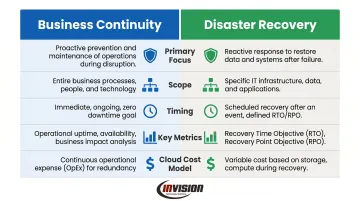
Here's how business continuity and disaster recovery compare across the dimensions that matter most for cloud planning:
| Category | Business Continuity | Disaster Recovery |
|---|---|---|
| Primary Focus | Keeping all critical business functions running | Restoring downed IT systems and data |
| Scope | Organization-wide: HR, operations, legal, IT | IT-specific: systems, applications, data |
| Timing | Proactive — built before disruption occurs | Reactive — activated after a disruption event |
| Key Metrics | Uptime, customer retention, regulatory compliance | RTO (recovery speed) and RPO (data loss tolerance) |
| Cloud Cost Model | Broader ongoing organizational investment | Low-cost backup-and-restore to high-cost active/active failover |
What Is Business Continuity in Cloud Computing?
ISO 22301 defines business continuity as an organization's capability to keep delivering products and services within acceptable timeframes during a disruption. In practice, BC is the organizational-wide strategy that addresses people, processes, and technology — not just the systems.
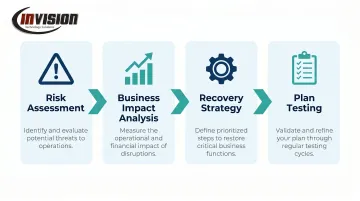
The Four Core Pillars of BC Planning
Every sound BC plan is built on these foundations:
- Risk Assessment — Identify what could realistically go wrong: cyberattacks, vendor outages, natural disasters, key staff absences
- Business Impact Analysis (BIA) — Quantify what each disruption would cost in revenue, compliance exposure, and operational impact
- Recovery Strategy — Define how critical functions continue during a crisis (manual processes, alternate tools, staff communication trees)
- Plan Testing — Validate the plan under realistic conditions before a crisis forces the test on you
Why Cloud Adds New BC Complexity
Cloud dependency introduces risks that traditional BC plans often miss. When a SaaS provider goes down, email, CRM, and file access can all disappear at once. A major Microsoft 365 outage in 2024 lasted over nine hours and generated nearly 16,000 outage reports. Any BC plan that skips vendor SLAs, alternative access methods, and data portability leaves your business exposed.
The Compliance Reality for Regulated Businesses
For Phoenix Metro healthcare practices, BC planning isn't optional. HIPAA's Security Rule (45 CFR 164.308(a)(7)) explicitly requires a Data Backup Plan, Disaster Recovery Plan, and Emergency Mode Operation Plan. Financial services firms face similar obligations under FINRA Rule 4370, which mandates written BCPs covering data backup and mission-critical systems.
Failing to document and test these plans can trigger audits, fines, or contract violations that compound the original disruption significantly.
What BC Downtime Actually Costs
The compliance stakes feed directly into the financial ones. Datto's SMB research puts the average ransomware-related downtime cost at $141,000 per incident for small and mid-sized businesses. For a medical practice that can't access patient records, or a law firm that can't retrieve case files, operational losses compound quickly — before any regulatory penalties enter the picture.
What Is Disaster Recovery in Cloud Computing?
Disaster Recovery is the IT-specific plan for restoring systems, data, and applications after a failure. Where BC keeps your organization functioning, DR focuses on getting your technology back online. In a cloud environment, DR uses geographic redundancy, automated backups, and failover mechanisms — without requiring a duplicate physical data center.
RTO and RPO: The Two Numbers That Drive Every DR Decision
Before choosing a DR approach, every business needs to define these two metrics for each critical system:
- Recovery Time Objective (RTO) — The maximum acceptable time a system can be down before the impact becomes unacceptable. NIST defines this as the overall length of time a system can remain in recovery before mission impact occurs.
- Recovery Point Objective (RPO) — The maximum acceptable amount of data loss, measured in time. If your RPO is four hours, your backup frequency must match that window.
Each system in your environment can have its own RTO and RPO. A patient scheduling system at a medical practice might require an RTO of 30 minutes; an internal HR database might tolerate several hours.
The Four Cloud DR Methods
AWS documentation outlines four primary cloud DR strategies, each representing a different trade-off between cost and protection:
| DR Method | Typical RTO | Typical RPO | Relative Cost |
|---|---|---|---|
| Backup and Restore | Hours to days | Hours | Lowest |
| Pilot Light | Tens of minutes to hours | Minutes | Low |
| Warm Standby | Minutes | Seconds to minutes | Medium |
| Active/Active Failover | Near-zero | Near-zero | Highest |
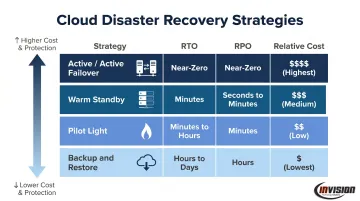
Most SMBs don't need active/active failover for every system. The right method depends on what each system's downtime actually costs your business — which is why the business impact analysis should drive your DR investment, not vendor defaults or one-size-fits-all recommendations.
The Shared Responsibility Gap
One of the most common and costly misconceptions: cloud providers handle DR automatically. They don't. AWS, Azure, and Google Cloud protect the underlying infrastructure — but configuring backups, testing recovery, and maintaining a DR plan within that infrastructure is the customer's responsibility.
Research from 2024 found that 87% of IT professionals experienced SaaS data loss — and only 35% achieved full recovery. Moving to the cloud doesn't automatically mean your data is protected; that gap requires deliberate configuration and ongoing oversight.
InVision Technology Solutions helps Phoenix Metro businesses close exactly that gap. Working with partners including Veeam and Barracuda Networks, InVision implements backup and DR solutions tailored to each client's RTO and RPO requirements. Their InWatch 24/7 monitoring system provides continuous oversight, catching issues before they escalate into full recovery events.
BC vs. DR: Which Does Your Business Actually Need?
The direct answer: most businesses need both. The real question is where to invest first and how deeply.
Prioritize BC Planning First If:
- Your organization has complex operational dependencies across multiple departments
- You're in a regulated industry — healthcare, legal, or finance — where continuity is a compliance requirement
- A significant portion of your staff depends on documented processes to keep working during a crisis
- Your downtime exposure extends beyond IT (patient care, client service, transaction processing)
Prioritize DR Investment First If:
- You're a smaller, IT-dependent operation where restoring data and systems is the single biggest vulnerability
- Your team is small enough that operational continuity is straightforward, but data loss would be catastrophic
- You're working with a limited budget and need immediate technical protection
Where BC and DR Intersect
The simplest way to understand the relationship: BC is the evacuation plan; DR is the fire suppression system. Both matter, and one without the other leaves you exposed.
Without BC, DR doesn't know which systems to prioritize restoring first. Without DR, BC has no technical mechanism to bring technology back online. The two are designed to run in parallel — each one reinforces what the other can't do alone.
That interdependence is exactly why one common assumption causes problems: equating cloud adoption with coverage. Just because data lives in the cloud doesn't mean it's protected or that operations will continue during an outage. Deliberate planning, documented procedures, and actual testing are still required.
InVision Technology Solutions works with Phoenix Metro businesses to assess their specific risk profile and identify the right combination of BC strategy and DR investment. A free network security assessment is a practical starting point for understanding where current gaps exist.
Real-World Scenario: When Both BC and DR Are Tested
The February 2024 Change Healthcare cyberattack illustrates what happens when BC and DR aren't treated as a combined framework. The attack disrupted claims processing and payment systems at national scale, with cascading effects across provider revenue cycles, billing workflows, and patient access. The American Hospital Association cited it as an urgent example of why individual healthcare organizations need to strengthen both cyber preparedness and continuity planning.
The organizations that fared best shared three traits: documented runbooks for continuing operations manually while IT systems recovered, pre-established communication protocols, and DR plans with defined RTO and RPO targets that had been tested before the incident.
Two things determined the outcome:
- BC processes — whether staff knew how to keep serving patients without EHR access, how to communicate internally, and how to maintain billing continuity through manual workflows
- DR mechanisms — whether IT could restore systems to a known-good state quickly, and whether backup data was actually recoverable

The Sophos 2025 State of Ransomware report found that the mean recovery cost across incidents reached $1.53 million, with 53% of victims recovering within one week. The difference between one week and one month of recovery time often comes down to whether a tested DR plan existed before the attack.
That gap is where preparation either pays off or reveals its absence. If your organization's BC and DR posture hasn't been formally tested, InVision Technology Solutions can assess where you stand. Contact our Scottsdale team at (480) 699-8077 or info@invisionaz.com for a no-obligation consultation specific to your industry.
Conclusion
BC and DR aren't competing priorities — they're complementary layers of the same resilience strategy. BC keeps your organization functioning during a crisis; DR gets your technology back online. The right investment in each depends on your industry, size, regulatory environment, and how much downtime your business can realistically absorb.
For Phoenix Metro businesses in healthcare, legal, or finance, having both a documented BC plan and a tested DR strategy is no longer optional — regulators, insurers, and clients increasingly expect it. The cloud makes both more achievable and cost-effective than traditional on-premises approaches, but getting there requires the right implementation partner. InVision Technology Solutions has helped Phoenix Metro businesses across healthcare, legal, and finance build and test BC and DR strategies that hold up when it matters. Contact InVision to assess your current resilience gaps.
Frequently Asked Questions
What is a business continuity and disaster recovery (BCDR) strategy?
BCDR is the combined framework of policies, plans, and technologies an organization uses to maintain operations and recover IT systems during or after any disruption. BC covers the human and process side — staff communication, manual workflows, regulatory compliance. DR covers the technical recovery side, restoring systems and data after a failure.
What is the difference between business continuity and disaster recovery in cloud computing?
In a cloud environment, BC focuses on keeping business operations running using cloud-based tools, redundant processes, and documented workflows. DR specifically uses cloud infrastructure — multi-region backups, automated failover, availability zones — to restore data and systems after a failure. The cloud makes both more flexible and cost-accessible than on-premises alternatives.
Does business continuity include disaster recovery?
Yes. DR is a subset of BC. BC is the broader organizational strategy covering people, processes, and technology; DR is the IT-specific component within it focused on restoring systems and data. Having a DR plan without a full BC plan leaves significant operational gaps — particularly around staff communication, manual workflows, and regulatory compliance.
Which should come first: business continuity planning or disaster recovery planning?
Business continuity planning should come first. The business impact analysis conducted during BC planning identifies which systems and operations are most critical — and that information directly determines the RTO and RPO targets that shape the DR investment. Building DR without BIA first often leads to misaligned priorities and misallocated budget.
How does cloud computing influence business continuity and disaster recovery?
Cloud computing lowers the cost and complexity of both BC and DR by providing geographic redundancy, automated backups, scalable failover environments, and pay-as-you-go pricing. However, businesses must still configure and test these capabilities deliberately — cloud adoption alone does not equal protection, as the shared responsibility model places data protection squarely on the customer.
What are the four pillars of business continuity planning?
Business continuity planning rests on four pillars:
- Risk assessment — identifying potential threats to operations
- Business impact analysis — quantifying the cost and effect of disruptions
- Recovery strategy — defining how critical functions will continue during an incident
- Plan testing and maintenance — validating that the plan holds up under real conditions, not just on paper