The threat isn't theoretical. Ransomware, phishing, and credential theft are hitting Phoenix Metro businesses in healthcare, legal, financial services, and beyond. What's changed recently is that attackers now use AI to craft more convincing attacks, probe more targets simultaneously, and adapt when initial attempts fail.
This article covers why SMBs are disproportionately targeted, how AI-powered cybersecurity works in practice, which capabilities matter most, and how businesses of any size — including those without a single IT staff member — can access effective protection at a predictable cost.
Key Takeaways
- 59% of SMEs were hit by a cyberattack in the past year — the "we're too small to target" assumption is simply wrong
- AI security tools detect threats using behavioral analysis, not just known signatures — so they catch attacks traditional antivirus never sees
- Cloud-based AI security runs on per-user pricing — no expensive hardware, no minimum headcount
- Outsourcing to a managed security provider typically costs far less than hiring even one in-house security analyst
- Prioritize email protection and MFA first, then build your security stack from a solid foundation
Why Small Businesses Are Prime Targets for Cyberattacks
Cybercriminals aren't just targeting Fortune 500 companies — they're actively hunting smaller businesses precisely because those businesses tend to have weaker defenses, no dedicated security staff, and less incident response capability. Small businesses represent easier access to real money and real data.
The Most Common Attack Types
Three attack types dominate the SMB threat landscape:
- Ransomware — Attackers encrypt business-critical files and demand payment to restore access. A dental practice in Scottsdale, for example, could find patient records and scheduling systems completely locked on a Monday morning, with no clear path to recovery.
- Phishing emails — A convincing email that appears to come from a vendor or bank tricks an employee into entering credentials. Those credentials then open the door to everything behind them.
- Data breaches — Customer records, payment information, and sensitive business data are exfiltrated and either sold or used for further fraud.
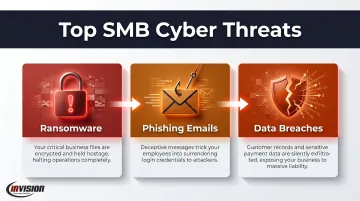
The 2025 Verizon Data Breach Investigations Report identifies ransomware as the defining breach pattern for small businesses, with phishing and credential theft remaining the primary access vectors.
The Real Cost of Getting Hit
Recovery from a cyberattack is expensive — not just in ransom payments or IT recovery costs, but in downtime, client trust, and regulatory exposure. For businesses in regulated industries like healthcare (HIPAA) or financial services (PCI-DSS, SOX), a breach can trigger fines on top of operational damage.
The Real Cost of Getting Hit
Recovery from a cyberattack is expensive — not just in ransom payments or IT recovery costs, but in downtime, client trust, and regulatory exposure. For businesses in regulated industries like healthcare (HIPAA) or financial services (PCI-DSS, SOX), a breach can trigger fines on top of operational damage.
The financial damage typically hits across several areas:
- Downtime costs — Lost revenue and productivity during days or weeks of recovery
- IT remediation — Emergency support, system rebuilds, and data restoration
- Regulatory fines — HIPAA violations can reach $50,000 per incident; PCI-DSS penalties vary by card processor
- Reputational damage — Client relationships that take years to build can unravel after a single breach notification
The Security Gap Attackers Count On
Most small businesses share a common profile that attackers recognize immediately:
- No dedicated IT security staff
- Outdated software or inconsistent patching
- Weak or reused passwords with no MFA enforced
- No written incident response plan
- Employees who haven't been trained to recognize phishing
AI Is Widening the Gap
Attackers now use AI themselves — and it's making traditional defenses less effective by the month. Specifically, they're deploying:
- AI-generated phishing emails that are more convincing than human-written versions, produced at scale targeting thousands of businesses at once
- Automated vulnerability scanners that probe networks continuously, looking for unpatched software or open ports
- Adaptive malware that rewrites its own code after failed detection attempts, evading signature-based antivirus tools
For Phoenix Metro businesses without dedicated security staff, this shift means the threat environment has changed faster than most defenses have kept up.
How AI Cybersecurity Solutions Work
Traditional antivirus software operates on signatures — it matches incoming threats against a database of known malware. If the threat is new, or has been slightly modified to avoid detection, signature-based tools miss it entirely. AI-powered security works differently. Rather than looking for known bad patterns, AI systems learn what normal looks like for your specific environment — which users log in at what times, how much data typically moves across the network, which devices connect from where. When something deviates from that baseline, the system flags it immediately.
Behavioral Baselines and Real-Time Anomaly Detection
This means a compromised account logging in at 2 a.m. from an unusual location gets flagged before any damage is done — even if the credentials used are technically valid.
Automated Threat Response
Response time is everything when a breach is underway. The IBM Cost of a Data Breach Report 2025 found that organizations using security AI and automation cut their average breach lifecycle by 99 days and saved an average of $2.22 million per breach compared to organizations with limited or no AI use.
When AI detects a threat, it doesn't wait for a human to respond. It can:
- Automatically isolate the affected device from the network
- Block suspicious outbound connections
- Alert administrators with full context
- Begin logging for forensic analysis
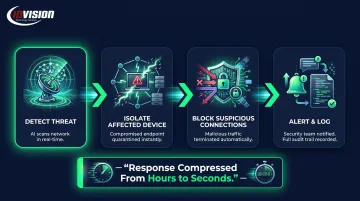
This compresses the response window from hours to seconds.
AI-Powered Email Protection
Most breaches don't start with exotic exploits — they start with a convincing email. Since phishing remains the top entry point for SMB attacks, email security deserves special attention. Machine learning models analyze message content, sender behavior, embedded links, and attachment patterns, intercepting suspicious emails before they reach any inbox. That's a step beyond basic spam filtering, which relies on blocklists rather than behavioral analysis.
Automated Patch Management
Unpatched software is a critical vulnerability. The 2025 DBIR reported an approximate eightfold increase in exploitation of edge device vulnerabilities year-over-year. AI-driven patch management continuously scans for unpatched software and misconfigurations, then prioritizes or applies fixes automatically — removing one of the most common reasons SMBs get breached.
Key AI Cybersecurity Capabilities Every SMB Should Have
Not every tool matters equally. These four capabilities address the highest-risk areas for small businesses specifically.
Endpoint Detection and Response (EDR)
Every laptop, phone, or workstation connected to your network is a potential entry point. AI-driven EDR tools monitor all endpoints continuously, contain threats at the device level, and prevent lateral movement across the network. CISA defines EDR as going well beyond signature matching — it's continuous monitoring with automated response built in.
For a law firm with attorneys working from multiple locations, or a medical practice with devices in every exam room, a compromised device in one location can spread across the entire network without it.
AI-Driven Identity and Access Management
Stolen credentials drive a large share of SMB breaches. MFA alone dramatically reduces that risk — CISA reports that MFA makes accounts 99% less likely to be compromised. AI enhances this further by monitoring login behavior and flagging access attempts that don't match established patterns, even when the credentials themselves are correct.
Cloud Security Monitoring
Most SMBs run on Microsoft 365, Google Workspace, or cloud storage of some kind — which means your attack surface extends well beyond your office walls. AI-powered cloud security monitors these environments around the clock for:
- Misconfigurations that leave data exposed to the public internet
- Unauthorized access attempts from unfamiliar locations or devices
- Unusual data movement, such as bulk downloads or transfers to unknown destinations
AI-Powered Threat Intelligence
Leading security platforms analyze millions of threat signals across industries and geographies, applying that global intelligence to protect individual businesses. A small accounting firm in Chandler benefits from threat awareness built on attack data from thousands of organizations worldwide — intelligence they could never build independently.
Is AI Cybersecurity Affordable for Small Businesses?
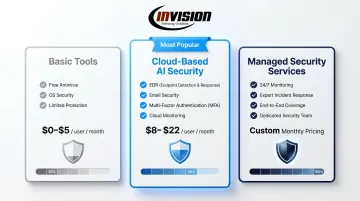
The perception that enterprise-grade security is out of reach for small businesses is outdated. Three realistic cost tiers exist:
| Tier | What It Includes | Approximate Cost |
|---|---|---|
| Basic tools | Free antivirus, built-in OS security | $0–$5/user/month — limited protection |
| Cloud-based AI security | EDR, email security, MFA, cloud monitoring | $8–$22/user/month (e.g., CrowdStrike Falcon Go at ~$8/device/month; Microsoft 365 Business Premium at $22/user/month) |
| Managed security services | 24/7 monitoring, expert response, end-to-end coverage | Custom pricing — predictable monthly rate |
The ROI Argument
A single breach can cost far more than months of proactive security. Common consequences include:
- Days of operational downtime
- Data recovery and forensic investigation costs
- Regulatory fines (HIPAA, PCI-DSS, or state-level breach laws)
- Client attrition from lost trust
All of that weighs against a monthly per-user investment that scales directly with your headcount.
Cloud-based tools eliminate the need for on-premises hardware entirely. A 15-person accounting firm pays for 15 licenses. Nothing more.
In-House IT vs. Outsourcing: What's Right for Your Business?
The In-House Approach
Businesses can implement meaningful baseline protections independently:
- Enforce MFA across all accounts
- Keep all software patched and updated
- Deploy cloud-based security tools (EDR, email security)
- Run periodic employee phishing simulations
- Document an incident response plan
This approach works — but it requires someone with genuine IT security competency to manage it, and it leaves gaps in 24/7 monitoring coverage. For most SMBs, that person doesn't exist on staff.
The Outsourcing Advantage
Partnering with a Managed IT or Managed Security Service Provider gives SMBs access to a full security team, around-the-clock monitoring, and professional-tier security tools at a fraction of what it costs to hire even one security analyst. The U.S. median annual salary for an information security analyst is $124,910 — well beyond what most small businesses can sustain. Managed services convert that into a predictable monthly cost instead.
InVision Technology Solutions for Phoenix Metro SMBs
For small businesses in Scottsdale, Phoenix, Chandler, Mesa, and the surrounding metro area, that outsourcing shift is exactly what InVision Technology Solutions delivers. Founded in 2006, InVision brings nearly two decades of experience serving SMBs in healthcare, legal, financial services, manufacturing, and professional services.
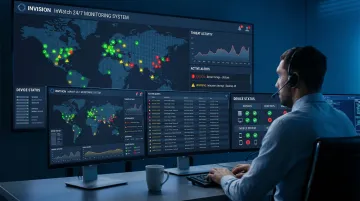
Their InWatch 24/7 monitoring system provides continuous oversight of servers, desktops, laptops, and network devices — with an average response time of five minutes. InVision holds both Cisco Security Specialized and Microsoft Silver Technology Partner certifications. They also offer a free network security assessment for businesses that want to understand their current vulnerabilities before committing to any plan — and no long-term contract is required.
How to Get Started with AI Cybersecurity
Getting started with AI cybersecurity doesn't demand a large upfront investment — it demands clarity about where your business is most exposed. These three steps give Phoenix Metro SMBs a practical on-ramp.
Conduct a security assessment first — Before spending anything, identify what data you hold, who has access to it, and where your biggest gaps are. InVision offers a free network security assessment; CISA also provides free risk assessment resources for small businesses.
Prioritize your highest-risk areas — For most SMBs, that means email security (phishing protection), endpoint protection (EDR), and access management (MFA and strong password policies). These three controls address the majority of SMB breach vectors.
Build a response plan — Tools alone won't protect you if employees can't recognize or report suspicious activity. Brief recurring training and a written incident response plan significantly reduce damage when something slips through.
If you're not sure where to begin, InVision's team can walk you through the assessment process and help you prioritize the right controls for your industry and risk profile.
Frequently Asked Questions
What is SMB security?
SMB security refers to the cybersecurity practices, tools, and policies used to protect small and medium-sized businesses from threats like ransomware, phishing, and data breaches. It encompasses both technology solutions (antivirus, EDR, MFA) and human practices like employee training and incident response planning.
Who needs cybersecurity services?
Any business that stores customer data, processes payments, uses cloud services, or relies on digital systems for operations needs cybersecurity services. Small businesses are especially in need — they're frequently targeted but often the least protected.
What are the most common cyber threats facing small businesses?
Ransomware, phishing and business email compromise, credential theft, and data breaches top the list. AI tools now help attackers craft more convincing phishing emails and evade the signature-based detection that traditional defenses rely on.
What is the difference between traditional antivirus and AI cybersecurity?
Traditional antivirus matches files against a database of known threats — if the threat is new or modified, it gets through. AI cybersecurity uses behavioral analytics to detect anomalous activity and can identify unknown threats in real time, before they cause damage.
How much does AI cybersecurity cost for a small business?
Cloud-based tools can start at roughly $8–$22 per user per month. Managed security services offer comprehensive 24/7 protection at a predictable flat rate. Both options are far less expensive than recovering from a single successful breach.
Can a small business get AI cybersecurity without an in-house IT team?
Outsourcing to a managed IT or security provider gives small businesses access to 24/7 AI-powered monitoring and expert response without any internal IT staff. For businesses under 50 employees, it's the most practical and cost-effective path.