Introduction
Picture this: your staff is complaining about slow systems again, a vendor just pitched you on migrating to the cloud, and you're not entirely sure whether your backups are actually working. You know you need IT help—but what kind?
This confusion is more common than most owners realize, and it's expensive. Calling in a consultant when your network needs daily management leaves your operations exposed. Signing up for managed services when your real problem is a lack of technology strategy means you're paying monthly fees without solving the underlying issue.
Getting this wrong affects uptime, security, and your team's ability to work without technology constantly getting in the way. What follows breaks down what each model actually includes, where they differ, and how to identify which one fits your situation right now.
Key Takeaways
- IT services = ongoing, hands-on management (help desk, monitoring, cybersecurity, backups)
- IT consulting = strategic advisory work (roadmaps, cloud planning, risk assessments, compliance)
- IT services keep systems running; IT consulting guides major decisions and technology changes
- Most small and mid-size businesses need both—often at the same time
- Working with one provider for both prevents misaligned priorities, wasted spend, and delays between planning and action
What Are IT Services?
IT services—typically delivered through a managed services model—cover the ongoing, hands-on work that keeps your technology running, secure, and up to date. Rather than hiring an internal IT team, businesses outsource day-to-day operations to a dedicated provider under a predictable monthly arrangement.
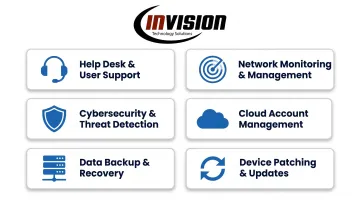
Common IT services include:
- Help desk and user support
- Network monitoring and management
- Cybersecurity tools and threat detection
- Cloud account setup and management
- Data backup and recovery testing
- Device patching and software updates
The managed services model gives businesses access to a broader bench of expertise than most could afford to hire internally. A small medical practice, for example, isn't going to employ a full-time network engineer, a security specialist, and a systems administrator—but through a managed services provider, they get all three.
Who Benefits Most
Small to mid-size organizations in regulated industries get the clearest return from managed IT services. Healthcare practices, dental offices, law firms, and accounting firms all rely heavily on technology but rarely have the scale to justify a dedicated internal IT department—which is exactly the gap managed services fills.
The operational case is concrete:
- Flat-rate or per-user pricing keeps monthly IT costs predictable
- Proactive monitoring catches problems before they cause downtime
- Faster incident response compared to reactive break-fix support
- Non-IT staff stop fielding tech issues informally
CompTIA's 2025 IT Industry Outlook reports that 37% of firms say SMB customers are now committed to an MSP, with 42% seeking more external help with newer technology—reflecting how quickly the complexity of modern IT is outpacing what most small teams can manage in-house.
What Is IT Consulting?
IT consulting is strategic advisory work. Where managed services focus on keeping systems running, consulting focuses on helping leadership make better technology decisions: assessing what you have, identifying gaps, and recommending a clear path forward rather than executing day-to-day tasks.
An IT consultant's work during an engagement typically includes:
- Auditing existing infrastructure and identifying gaps
- Building a technology roadmap aligned with business goals
- Guiding cloud migrations or system upgrades
- Advising on compliance requirements (HIPAA, SOX, GLBA, PCI DSS)
- Producing risk assessments or migration plans as defined deliverables
How Consulting Engagements Are Structured
Unlike managed services, consulting is generally project-based, with a defined scope, timeline, and deliverables. The engagement has a clear beginning and end, whether that's a written roadmap, a compliance assessment report, or a migration plan. Your business knows exactly what it's getting and when.
The Strategic Value
IT consulting prevents the most expensive kind of mistake: a major technology decision made without expert input. IBM's 2024 Cost of a Data Breach Report puts the average breach cost at $4.88 million—much of which traces back to decisions made (or skipped) long before the incident occurred.
Consulting is especially valuable when:
- Planning a cloud migration or infrastructure refresh
- Opening a new location or replacing legacy systems
- Facing a compliance audit (HIPAA penalties now range from $145 per violation up to $2.19 million annually)
- Responding to a security incident that revealed strategic gaps
- Building a 1-to-3-year technology investment plan
IT Services vs. IT Consulting: Key Differences That Matter
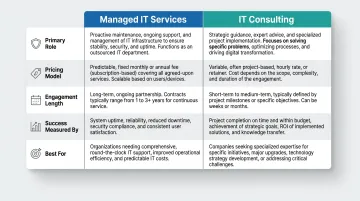
Both involve working with IT professionals, but the role, pricing, and success metrics look nothing alike. Confusing the two leads to mismatched expectations and wasted budget.
| Dimension | Managed IT Services | IT Consulting |
|---|---|---|
| Primary role | Ongoing operations under SLAs | Advisory, planning, and projects |
| Pricing model | Monthly per-user or per-device | Hourly or fixed-fee per project |
| Engagement length | Ongoing, open-ended | Time-bound with defined deliverables |
| Success measured by | Uptime, response times, patch compliance | Risk reduction, ROI, on-time delivery |
| Best for | Daily monitoring, support, security ops | Roadmaps, migrations, compliance audits |
Doers vs. Planners
IT services teams are embedded in daily operations—responding to tickets, monitoring systems, applying patches, resolving incidents. IT consultants step in for defined projects or strategy sessions; they're not responsible for ongoing upkeep.
Your MSP keeps the plane in the air. Your consultant decides where it's heading.
When They Overlap
That distinction matters—but in practice, the line isn't always this clean. Many providers blend both roles, and there are real advantages when they do. When the same team handles your daily operations and advises on long-term direction, you get:
- No gap between strategy and the people executing it
- No vendor coordination hassles across separate firms
- No risk of a consultant recommending tools your support team has never touched
How to Know Which One Your Business Needs
You Probably Need Managed IT Services If:
- Staff regularly complain about slow systems, Wi-Fi drops, or printer problems
- Non-IT employees are the de facto "tech people" in your office
- No one owns cybersecurity, backups, or compliance in a formal way
- Downtime regularly interrupts productivity with no clear resolution path
- You're in a regulated industry (healthcare, legal, dental, financial) without documented security controls
You Probably Need IT Consulting If:
- You're planning a cloud migration, software rollout, or infrastructure refresh
- Leadership isn't sure how to align IT spending with business growth goals
- A compliance audit is approaching and you're not confident in your readiness
- A security incident has revealed gaps that daily support alone can't address
- You need a technology roadmap before committing to major capital investments
Why Most Businesses Need Both
If you recognized your situation in both lists above, that's common. Most businesses need consulting to set direction and managed services to execute the plan and maintain stability between strategic projects.
Without consulting, great recommendations sit unimplemented. Without managed services, a solid strategy has no one keeping the lights on day to day.
The Verizon 2025 Data Breach Investigations Report SMB Snapshot recorded 2,842 confirmed breaches among companies with fewer than 1,000 employees—99% financially motivated. Three attack patterns accounted for 96% of incidents. That kind of threat profile requires both the tactical coverage of managed services and the strategic architecture of consulting to counter effectively.
How InVision Technology Solutions Can Help
InVision Technology Solutions has been serving Phoenix Metro businesses since 2006 from its Scottsdale headquarters—nearly 20 years of working with healthcare practices, law firms, dental offices, manufacturing facilities, accounting firms, and professional services organizations across the Valley.
That experience is backed by verified credentials: Microsoft Silver Technology Partner, Select Certified Cisco Partner, and Certified Office 365 Provider, with additional partnerships with Dell, HPE, VMware, Veeam, and Barracuda.
What sets InVision apart for Phoenix Metro businesses:
- Two dedicated engineers assigned to every client (primary and secondary systems administrators, plus a technical manager and account manager)
- Average response time of 5 minutes, with a written 1-hour guarantee for managed service clients
- 99.9% system uptime with 24/7 network monitoring through the InWatch platform
- Over 245,000 threats blocked through proactive monitoring and detection
- No long-term service commitment required: clients can start with as-needed support and scale as needs grow
- HIPAA compliance support for healthcare and dental clients; SOX, PCI DSS, and GLBA support for financial and accounting firms

The approach matters as much as the credentials. Tony Avalos, Financial Controller at The Quantum Group, notes that InVision has "helped improve the many facets of our IT infrastructure, accommodating company growth, and in a manner that provides excellent service and protects our Company."
Ania Leyko, Finance Manager at Allergy Asthma Clinic, describes a 10-year relationship where InVision's team "anticipate, prepare and address potential IT threats before they can hinder our operations."
Those results reflect how InVision operates: managed services and IT consulting under one roof, covering infrastructure upgrades, data migration, network design, project management, and compliance readiness alongside 24/7 monitoring and help desk support. The same team that advises on a technology roadmap also manages the implementation, so clients aren't coordinating between separate vendors with different priorities.
Conclusion
Choosing between IT services and IT consulting isn't a one-time decision. Businesses move back and forth depending on where they are in their technology journey—consulting for major pivots and new initiatives, managed services for daily reliability and security.
The right provider matches your business on capabilities, communication style, and engagement model—not just technical credentials. That fit matters more than raw horsepower, especially as your needs evolve.
If you're still weighing your options, starting with an assessment cuts through the guesswork. InVision offers a free network security assessment for Phoenix Metro businesses to identify gaps and priorities before committing to any engagement. Reach the team at (480) 699-8077 or info@invisionaz.com to get started.
Frequently Asked Questions
What is the difference between IT services and IT consulting?
IT services cover ongoing, hands-on management of your technology—help desk support, network monitoring, cybersecurity, and backups. IT consulting is strategic advisory work focused on planning, technology roadmaps, and aligning IT decisions with business goals. One keeps systems running; the other guides where those systems are headed.
What does an IT consultant do?
An IT consultant audits your current infrastructure, identifies gaps and risks, and builds a technology roadmap. Engagements are project-based with defined deliverables: a written plan, risk assessment, or migration strategy.
What is an IT consulting service?
An IT consulting service is a project-based engagement where an IT professional provides strategic advice to help a business make better technology decisions. The consultant advises on what systems you need and why—not managing or maintaining them day to day.
What does an IT support consultant do?
An IT support consultant bridges strategy and execution, providing advice while also helping implement or support the recommended solutions. This model is common with managed services providers who bundle consulting and day-to-day operational support under one engagement.
What are examples of IT services?
Common IT services include help desk and user support, network monitoring and management, cybersecurity and threat detection, data backup and recovery, cloud infrastructure management, and device patching and updates—typically delivered under a monthly managed services agreement.
How much should an IT consultant charge?
Rates vary by scope, complexity, and expertise. According to Clutch's 2026 IT Services Pricing Guide, U.S. IT services average $100–$149 per hour, with most projects falling in the $10,000–$49,900 range. Common engagement models include hourly billing, fixed-fee projects, and retainers. Always request a written proposal with a clearly defined scope before committing.