Introduction
Getting a straight answer on managed IT pricing is harder than it should be. Two businesses with similar headcounts can receive quotes that differ by $150 or more per user per month — with no clear explanation of why. That gap usually comes down to service scope, compliance requirements, and whether the MSP is quoting the same things at all.
The market has grown to reflect just how critical this decision has become. Nearly 90% of SMBs currently use an MSP or are actively considering one, according to JumpCloud's 2024 research — and for good reason. The challenge isn't finding an MSP; it's understanding what you're actually buying before you sign.
Yet adoption alone doesn't guarantee a good outcome. Most businesses hit one of three snags: they underbudget for their real needs, compare quotes that cover different services, or choose the cheapest plan and end up patching gaps with add-ons that cost more in total.
This guide covers 2026 pricing ranges, breaks down how each pricing model works, and identifies what drives costs up or down. By the end, Phoenix Metro businesses will have a clear framework for evaluating quotes and choosing a plan that fits their actual needs.
Key Takeaways
- Managed IT services typically cost $99–$400 per user or device per month in 2026, depending on service scope and business complexity
- The three main pricing models — per-user, per-device, and flat-fee — suit different business types and device configurations
- The biggest cost drivers are compliance requirements, environment complexity, device-to-user ratio, and service scope
- The lowest monthly quote rarely means the lowest total cost; budget MSPs often add supplemental charges that exceed what a full-service plan would have cost
How Much Do Managed IT Services Cost in 2026?
Managed IT services don't carry a universal price tag — costs vary based on service level, business size, industry, and infrastructure complexity. The most common mistake businesses make is comparing monthly fees across MSPs without confirming whether those fees cover the same services.
Most pricing structures fall across three broad tiers. Mapping your business to the right one before requesting quotes will save time and prevent apples-to-oranges comparisons.
Monitoring-Only / Entry-Level
Included: Remote monitoring and alerting for servers and endpoints, basic patch management, and notifications when something goes wrong. Remediation — actually fixing the problem — is billed separately.
Typical pricing: Approximately $20–$50 per device per month for monitoring-only plans, based on current industry benchmarks.
Best for: Very small businesses with minimal compliance needs and an internal resource who can action alerts. Not appropriate for regulated industries like healthcare or legal, where unresolved alerts carry real liability.
Standard Managed IT Services / Mid-Range
Included: This is the most common engagement level for SMBs. Plans typically cover:
- Help desk support (remote and onsite)
- Proactive monitoring and patch management
- Endpoint security and network management
- Backup and disaster recovery
Typical pricing: According to The Network Installers' 2026 pricing guide, standard managed IT services range from $100–$300 per user per month, with most businesses falling between $150–$200.
Best for: Small to mid-size businesses in the Phoenix Metro area with 10–150 users who need reliable day-to-day IT support. Professional services firms, accounting practices, and manufacturing operations are typical fits. InVision Technology Solutions structures its managed plans for exactly this segment — with dedicated engineer assignments and 24/7 InWatch monitoring built in.
Full-Service / Compliance-Grade
Included: Everything in the mid-range tier, plus:
- Advanced cybersecurity and compliance program management (HIPAA, SOC 2, financial regulations)
- Virtual CIO/CTO strategic guidance and technology roadmap development
- Dedicated account management
Typical pricing: $250–$400 per user per month, with cybersecurity-bundled plans running $175–$325+ depending on security stack depth.
Best for: Regulated industries — healthcare, dental, legal, and finance — that need both operational IT management and a documented compliance posture. Growth-stage businesses that require strategic IT planning alongside daily support also fit well here.
What's Not in the Monthly Fee
Beyond recurring fees, total managed IT cost includes:
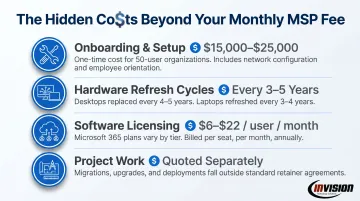
- Onboarding and setup: Typically equivalent to one month of service for smaller organizations; $15,000–$25,000 for 50-user organizations with complex infrastructure
- Hardware refresh cycles: Planned every 4–5 years for desktops, 3–4 years for laptops
- Software licensing: Microsoft 365 Business Basic runs $6/user/month; Business Standard is $12.50; Business Premium is $22.00 — usually billed as a pass-through
- Project work: Infrastructure upgrades, new location buildouts, and migrations are typically quoted separately
Managed IT Services Pricing Models Explained
The same monthly figure can mean completely different things depending on which pricing model produced it. A $150/month quote from one MSP and $150/month from another may cover entirely different scopes — so understanding these models before comparing quotes saves real confusion.
Per-User Pricing
One flat monthly fee per employee using IT services, typically tied to active email addresses or domain accounts. This is the most common model for standard managed IT services and scales predictably with headcount.
The limitation: it assumes roughly one device per person. A business with more devices than users — shared workstations in a medical practice, floor terminals in a manufacturing facility — will find per-user pricing either understates costs or leads to disputes about what's covered.
Per-Device Pricing
A fixed monthly cost per supported endpoint. Current 2026 benchmarks:
| Device Type | Monthly Cost Range |
|---|---|
| Desktop / Laptop | $50–$150/device |
| Server | $150–$500/server |
| Network equipment | $30–$75/device |
Per-device pricing works well for businesses with unusual device-to-user ratios. A 15-user dental practice with 35 devices — imaging stations, front desk terminals, shared exam room workstations — is realistically a 35-device environment, and per-device pricing reflects that accurately.
Flat-Fee / Tiered Plans
Bundled service packages under a single monthly rate, often labeled "Essential," "Standard," and "Premium" or equivalent. For example, InVision Technology Solutions structures their plans as Basic, Bronze, Silver, and Platinum — each tied to their InWatch 24/7 monitoring platform — so clients know exactly what's included at each level.
One important caveat: tier names aren't standardized across the industry. A "Silver" plan at one MSP may include endpoint detection and response; at another, it may only cover monitoring. Always read what's actually included, not just the tier label.
On hourly pricing: This model is reserved for one-off projects and consulting work, not ongoing managed services. Any MSP quoting hourly rates for regular IT management is operating reactively — a meaningful red flag if your goal is proactive support.
Key Factors That Affect the Cost of Managed IT Services
Headcount is the starting point, not the whole story. Environment complexity, compliance obligations, and service scope often influence pricing more than employee count does.
Business Size and Device-to-User Ratio
MSPs price based on what they actually manage. A medical practice with 15 employees and 40 devices — shared workstations, check-in stations, imaging equipment — is priced as a 40-device environment regardless of headcount. Phoenix Metro healthcare and dental practices run into this regularly, and per-user quotes significantly underestimate the actual scope.
Infrastructure Complexity
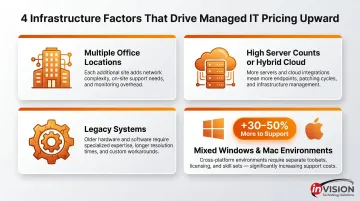
Several factors push managed IT costs upward:
- Multiple office locations requiring onsite support across sites
- High server counts or a mix of on-premise and cloud infrastructure
- Legacy systems requiring specialized knowledge to maintain
- Mixed Windows/Mac environments, which typically cost 30–50% more to support due to separate toolsets, dual testing requirements, and more complex troubleshooting
Compliance Requirements
Regulated industries — healthcare (HIPAA), dental, legal, and finance — require dedicated compliance staff, specialized tools, audit documentation, and ongoing policy management. Compliance requirements like HIPAA can increase managed IT costs by 25–50%, with standalone HIPAA compliance running $4,000–$50,000+ per year for small to mid-size practices.
This is especially relevant in the Phoenix Metro market, where healthcare practices, law firms, and accounting firms make up a significant share of the SMB landscape. InVision Technology Solutions has worked with regulated clients in these industries for nearly two decades, with HIPAA compliance integrated into their healthcare IT support plans from day one.
Scope of Services
Maintenance-only MSPs cover monitoring, patching, and help desk. Full-service MSPs add strategic functions: vCIO/vCTO advisory, technology roadmaps, and security consulting. The gap matters because a lower monthly fee from a maintenance-only provider doesn't eliminate the need for strategic IT guidance, it just means you'll pay for it separately, often at a higher combined cost.
MSP Certifications and Specialization
Certifications like Microsoft Silver Technology Partner and Cisco Security Specialized signal higher technical standards and vendor accountability. For businesses running Microsoft 365 or Cisco network infrastructure, this has a practical impact: certified partners have direct escalation paths and vendor support access that uncertified providers don't.
InVision Technology Solutions holds both certifications, giving Phoenix Metro clients direct access to those escalation resources when managing Microsoft 365 environments and Cisco-based networks.
Full-Service MSP vs. Budget MSP — What's the Real Difference?
A lower monthly fee is easy to justify in a budget meeting. The problem is that the real cost comparison plays out over 12–36 months, not on a single invoice.
The Fragmentation Problem
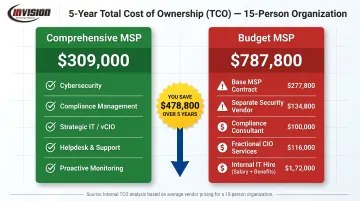
Budget MSPs typically cover monitoring and help desk — not cybersecurity, compliance management, or strategic planning. Those functions don't disappear; they get sourced separately. A business paying $1,500/month to a budget MSP may quietly add:
- A standalone cybersecurity vendor
- A compliance consultant for annual audits
- A fractional CIO for technology planning
When combined, that supplemental spending often exceeds what a full-service MSP would have cost from the start.
The numbers bear this out. For a 15-person organization, E-N Computers' 2026 cost analysis estimates five-year total cost of ownership at approximately $309,000 with a comprehensive MSP versus $787,800 with a budget MSP — once security services, compliance costs, and the internal IT hire typically needed to fill service gaps are included.
Hidden Operational Costs
Beyond supplemental vendors, budget MSPs carry operational costs that don't appear in monthly fees:
- Offshore support with slower resolution times
- Rotating technicians with no retained knowledge of your environment
- Reactive planning that leads to emergency hardware replacements costing 30–40% more than planned refreshes
Those gaps compound over time. By contrast, a full-service MSP provides dedicated engineers, local support, and documented technology roadmaps — resources that prevent the reactive scrambles that drive costs up. InVision, for example, assigns every client a primary and secondary systems administrator alongside a technical manager and account manager. The team supporting your environment actually knows it, which makes a measurable difference when problems arise.
How to Estimate the Right Managed IT Budget
The right budget starts with what your business actually needs, not what the lowest quote covers. Before requesting proposals, answer these questions:
- How many users and devices need support?
- Are there multiple office locations requiring onsite coverage?
- Does the industry carry compliance requirements (HIPAA, financial regulations)?
- Is the MSP the entire IT function, or is there existing internal IT staff?
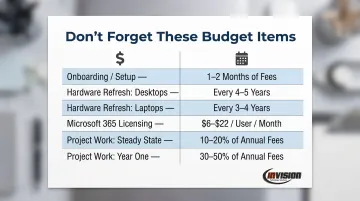
Commonly Missed Budget Items
| Cost Category | Typical Range |
|---|---|
| Onboarding / setup | 1–2 months of service fees |
| Hardware refresh (desktops) | Every 4–5 years |
| Hardware refresh (laptops) | Every 3–4 years |
| Microsoft 365 licensing | $6–$22/user/month depending on plan |
| Project-based work (steady state) | 10–20% of annual MSP fees |
| Project-based work (year one) | 30–50% of annual MSP fees |
What to Expect From a Transparent MSP
A well-run MSP should provide a detailed service proposal before you sign. That proposal should clearly define:
- What's included in the monthly fee
- What's explicitly excluded
- How the MSP scopes and bills project work separately
InVision Technology Solutions works this way with Phoenix Metro businesses. Their quoting process takes about 15 minutes over the phone, and onboarding can begin the following business day once approved. For a scoped quote based on your specific environment, contact InVision at (480) 699-8077 or info@invisionaz.com.
Conclusion
Managed IT services pricing in 2026 varies significantly — service tier, pricing model, environment complexity, and compliance requirements each play a role. The businesses that budget most effectively are the ones who understand what's actually inside a quote, not just the monthly number.
The right managed IT investment covers daily operational support and proactive security — at a cost that holds up when you weigh it against the expense of downtime, breaches, or reactive break-fix calls.
Phoenix Metro businesses have the advantage of working with local providers who understand the regional market and the industries they serve — including healthcare, dental, legal, and manufacturing. InVision Technology Solutions has served Phoenix Metro businesses across those industries since 2006 — if you're comparing quotes or building a budget, they're worth a conversation.
Frequently Asked Questions
How much do managed IT services cost?
In 2026, managed IT services typically cost between $99 and $400 per user or device per month, depending on service level. Monitoring-only plans start lower; full-service compliance-grade plans with advanced security and strategic guidance sit at the higher end. Actual cost depends heavily on business size, infrastructure complexity, and scope.
What are the pricing models for managed IT services?
The three main models are per-user (flat fee per employee), per-device (flat fee per supported endpoint), and flat-fee/tiered plans (bundled scope at a single monthly rate). The right model depends on your device-to-user ratio — businesses with more devices than users are often better served by per-device pricing.
How much does an MSP cost for small businesses?
Small businesses under 25 employees with standard IT needs typically fall in the $150–$200 per user per month range for managed services. Regulated industries like healthcare or legal often pay 25–50% more due to compliance requirements.
How much does an MSP charge per workstation?
Per-device pricing for workstations typically runs $50–$150 per device per month. Servers cost more : generally $150–$500/month.
What is included in managed IT services?
Standard plans typically include help desk support, 24/7 monitoring, patch management, endpoint security, and backup and disaster recovery. Full-service plans add strategic guidance, compliance support, and vCIO services. Monitoring-only plans exclude remediation — any remediation work is billed separately.
How much does an MSSP usually cost?
Managed Security Service Providers typically charge $2,000–$7,000+ per month for small businesses, depending on security scope. Many full-service MSPs now bundle core security functions (endpoint protection, threat monitoring, patch management) directly into managed IT plans, removing the need for a separate MSSP contract.