Introduction
Picking the wrong managed service provider doesn't just mean slow response times — it means compliance gaps that expose patient records, security vulnerabilities that invite ransomware, and downtime that costs real money while your team waits for help.
The stakes are higher than most businesses realize. According to ITIC's 2024 Hourly Cost of Downtime Report, 90% of mid-size and large enterprises report hourly downtime costs exceeding $300,000. For smaller firms, even modest outages can be devastating — 20% of SMBs say they couldn't survive a breach costing as little as $10,000.
Those risks don't get easier to manage in a crowded market. In Phoenix Metro — where the Arizona IT consulting industry is valued at $13.1 billion — businesses have no shortage of MSP options. More choices mean more noise, not more clarity.
This guide breaks down the criteria that matter most when selecting an MSP in 2026, so you can move past the sales pitch and choose a provider your business can actually rely on.
Key Takeaways
- An MSP handles IT infrastructure, security, and support so your team can focus on running the business
- Evaluate providers on certifications, cybersecurity depth, SLA specifics, pricing transparency, and scalability — not just price
- Industry-specific experience and after-hours incident response are often the real differentiators
- Ask pointed vetting questions before signing; the specificity of an MSP's answers tells you more than their sales pitch
- The best MSP relationship functions as a long-term technology partnership, not a ticket-closing service
What Is a Managed Service Provider (MSP)?
An MSP is a third-party company that takes ongoing, proactive responsibility for managing a client's IT systems — infrastructure, security, end-user support, and more — under a defined service agreement. This is fundamentally different from the traditional break-fix model, where IT help only arrives after something fails.
MSPs generally fall into three tiers:
- Lower-level: Monitoring and alerting only — reactive in practice despite the proactive label
- Mid-level: Proactive management, cloud services, disaster recovery, and helpdesk support
- High-level: Full-spectrum IT including VoIP, strategic planning, compliance support, and analytics
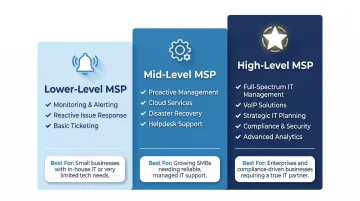
Most growing businesses in regulated industries — healthcare, legal, finance — need a mid- to high-level MSP.
Core Services MSPs Typically Provide
The range of services varies significantly between providers, which is why matching service scope to business needs is the first step in any evaluation:
- 24/7 network monitoring and alerting
- Cybersecurity (endpoint protection, threat detection, firewall management)
- Cloud management and Microsoft 365 support
- Helpdesk and end-user support
- Data backup and disaster recovery
- Compliance support (HIPAA, PCI-DSS, SOX)
- IT strategic planning and vCIO services
Why Businesses Rely on MSPs
That service scope explains the core appeal: MSPs eliminate constant reactive IT work and give businesses access to enterprise-grade expertise without the cost of building an in-house team. Nearly 90% of SMEs already use or are considering an MSP. For most businesses today, outsourcing IT management is simply the standard approach — not a cost-cutting workaround.
Key Criteria for Choosing the Right MSP in 2026
Selecting an MSP requires evaluating technical capabilities alongside business alignment. A provider with impressive credentials that doesn't understand your industry or communicate effectively won't deliver real value. The following criteria help you move beyond surface comparisons.
Certifications, Expertise, and Industry Experience
Credentials from Microsoft, Cisco, and CompTIA signal that an MSP's team has met third-party standards — not just internal self-assessments. These aren't just logos; they represent specific training, testing, and ongoing requirements.
A few things worth knowing about current certifications:
- Microsoft replaced legacy Silver/Gold designations with six Solutions Partner designations requiring a minimum of 70 points across performance, skilling, and customer success. Ask specifically which current designation an MSP holds.
- Cisco is transitioning to the Cisco 360 Partner Program, retiring legacy Select, Premier, and Gold tiers
- CompTIA Security+ validates core security functions and is DoD-approved under Directive 8140 — relevant for any MSP claiming security expertise
Credentials only go so far. Industry-specific experience determines whether an MSP can actually operate in your environment. An MSP supporting a medical practice must understand HIPAA business associate requirements. One serving a law firm must grasp data confidentiality obligations. One handling financial clients needs familiarity with PCI-DSS and SOX.
Before committing, ask for client references in your specific vertical — not just general testimonials.
Service Scope and Proactive Support Model
The distinction between reactive and proactive MSPs matters more than most buyers realize:
- A reactive MSP resolves problems after they occur — your downtime is their trigger
- A proactive MSP uses continuous monitoring, root cause analysis, and preventive maintenance to stop issues before they disrupt operations
Ask any MSP candidate for their average ticket resolution time and mean time between incidents. Vague answers signal a reactive culture dressed up in proactive language.
Response metrics aside, scope coverage is the other half of the equation. Confirm the MSP handles what your business needs today and over the next 18–36 months:
- Cloud and Microsoft 365 management
- Endpoint protection and patch management
- VoIP support if applicable
- Compliance documentation and risk assessments
- Strategic IT planning
Cybersecurity Capabilities and Compliance Support
SMBs experience ransomware breaches at 88% compared to 39% for large enterprises, and 43% of all cyberattacks target small businesses. The global average cost of a data breach reached $4.4 million in 2025.
Ask MSP candidates specifically about:
- 24/7 threat monitoring and endpoint detection and response (EDR)
- Firewall management and configuration
- Their incident response plan — including how they communicate with clients during an active breach
- Whether they've been audited or reviewed against CISA's joint advisory on MSP supply chain risks (CISA Advisory AA22-131A explicitly warns that MSPs are targeted as access vectors to compromise multiple client networks simultaneously)
For regulated industries, compliance support carries its own requirements:
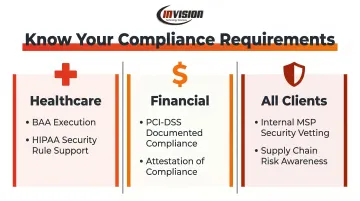
- Healthcare clients: The MSP must execute a Business Associate Agreement (BAA) and support HIPAA Security Rule requirements
- Financial clients: Look for documented PCI-DSS service provider compliance, including Attestation of Compliance
- All clients: A vulnerable MSP creates a backdoor into your data — vet their internal security practices as rigorously as their client-facing capabilities
Response Times, SLAs, and Uptime Guarantees
An SLA is only as valuable as what it actually commits to. Vague language like "timely support" or "best-effort response" offers no real protection.
Look for specific, enforceable commitments:
| Metric | What to Look For |
|---|---|
| Emergency response time | Under 10 minutes, guaranteed in writing |
| Helpdesk availability | 24/7 vs. business hours only |
| System uptime | 99.9% minimum with defined measurement |
| Issue resolution time | Average time, not just response time |
The operational gap between a 5-minute response commitment and a 4-hour window is enormous. For a company with 50 employees and $10M in annual revenue, a single day of complete downtime can cost approximately $52,840 in lost revenue and productivity — that's not a theoretical risk, it's a documented business outcome.
Request a sample SLA before any conversation about pricing.
Transparent Pricing and Contract Flexibility
Hidden fees and auto-renewing multi-year contracts are among the most common complaints businesses have after signing with an MSP. Common pricing models include per-user, per-device, and flat monthly fees — the right structure depends on your environment, but clarity matters more than the specific model.
Red flags in pricing proposals:
- Vague scope boundaries that create "out-of-scope" charges
- Bundled services you can't itemize individually
- Multi-year commitments with substantial exit penalties
- Discounts contingent on signing extended contracts
An MSP confident in their service quality doesn't typically need to lock clients into long terms. Shorter terms or no mandatory commitment period is a signal that the provider expects to earn continued business through performance — not contractual obligation.
Scalability and Long-Term Partnership Fit
As your headcount, locations, or technology stack grows, your MSP must scale alongside you. The average annual MSP customer churn rate is approximately 12%, with 36% of MSPs reporting retention rates below 50% — meaning many providers lose clients faster than they acquire them. That's a signal worth taking seriously.
Ask how an MSP has supported other clients through growth phases. Can they add users, devices, or locations without service degradation? Do they offer dedicated account management, or will you be bouncing between different technicians who don't know your systems?
Cultural fit matters too. Look for:
- Dedicated points of contact who know your environment
- Regular business reviews (not just incident reports)
- An MSP that asks about your business goals, not just your hardware inventory
The right MSP connects your technology decisions to your business direction. That conversation should start at onboarding and continue through every quarterly review.
Questions to Ask a Potential MSP Before Signing
The right questions cut through rehearsed sales responses. An MSP's willingness to answer with specificity — not generality — signals how well they actually run their operations.
Ask these before committing:
- What is your guaranteed emergency response time, and is it in writing? "We try to respond quickly" is not an SLA. Get the number and get it documented.
- Can you provide three client references in our specific industry? General references don't prove vertical expertise. A healthcare practice has different compliance needs than a law firm.
- What compliance frameworks do you actively support? For healthcare clients, ask specifically whether they maintain a BAA. Knowing what HIPAA requires isn't the same as actively supporting it.
- How do you handle a cybersecurity incident at 2am on a Sunday? Ask for the actual escalation process — who gets called, in what order, and how fast.
- Do you require a long-term service commitment? How they answer this reveals how confident they are in their own performance.
- Can we see a sample SLA before moving forward? Any reputable MSP provides this without hesitation.
Review the sample SLA alongside the pricing proposal. Discrepancies between what's promised verbally and what appears in the contract happen more often than you'd expect — and those gaps tend to show up at exactly the wrong moment.
How InVision Technology Solutions Can Help
InVision Technology Solutions has been serving Phoenix Metro businesses since 2006 — across healthcare, legal, finance, manufacturing, and professional services. That's 20 years of regional experience, with Microsoft Silver Technology Partner, Select Certified Cisco Partner, and Cisco Security Specialized credentials — backed by a founding commitment to long-term client relationships built on trust and integrity.
Here's how those credentials translate into day-to-day service delivery:
- 5-minute average response time (with a written 1-hour guarantee for all managed service clients)
- 99.9% system uptime supported by the InWatch 24/7 monitoring platform
- Two dedicated engineers per client — a primary and secondary systems administrator who know your environment
- 24/7 network monitoring and threat detection as standard, not an add-on
- No long-term service commitment required — flexible plans from Basic to Platinum
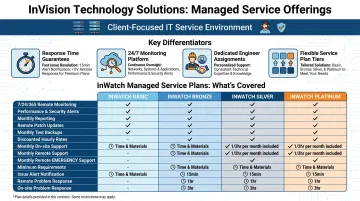
Additional differentiators include dedicated client coordinators for consistent communication, local support teams based throughout the Phoenix Metro area, and upfront pricing with no hidden fees. InVision serves clients across the full business size spectrum — from 10-person practices to 250-employee organizations — with scalable plans that adjust as client needs evolve.
Clients like Allergy Asthma Clinic, Ltd. — a healthcare partner for over a decade — say the biggest change was being able to focus on patient care again, without IT problems pulling attention away. That's what the right MSP relationship actually delivers.
To discuss your IT needs and see what this kind of partnership looks like in practice, contact InVision at 480-699-8077 or info@invisionaz.com.
Conclusion
The right MSP in 2026 earns the role through certifications, service model, response commitments, and pricing that fit how your business actually operates — not through a polished pitch deck.
Evaluate the SLA carefully. Verify compliance capabilities in writing. Ask the uncomfortable questions about after-hours incidents. And revisit those expectations at least annually — your IT requirements in year three look different than they did at onboarding. The right partner schedules those reviews without being asked.
If you're a Phoenix Metro business evaluating MSPs against these criteria, InVision Technology Solutions has served businesses across healthcare, legal, manufacturing, and professional services since 2006 — with no long-term contracts required and an average response time of five minutes. It's worth seeing how those numbers hold up against your checklist.
Frequently Asked Questions
What are the different types of managed service providers?
MSPs generally fall into three tiers by scope. Entry-level providers handle monitoring and alerting only. Mid-tier providers add proactive management, cloud services, and disaster recovery. High-level providers deliver full-spectrum IT — including communications and strategic planning. Match the tier to your business complexity and growth stage.
What counts as a Managed Service Provider?
An MSP is a third-party company that takes ongoing, proactive responsibility for managing a client's IT systems under a defined service agreement. This distinguishes them from break-fix vendors or one-time IT consultants who only respond when called — not before problems occur.
How do I choose the right Managed Service Provider?
Define your IT needs and compliance requirements first, then evaluate providers on certifications, service scope, cybersecurity depth, SLA specifics, and pricing transparency. Vet finalists with direct questions and industry-specific client references before signing anything.
What is the difference between an MSP and an MSSP?
An MSP covers broad IT management — infrastructure, helpdesk, cloud, and general security. A Managed Security Service Provider (MSSP) specializes exclusively in cybersecurity, typically operating a dedicated Security Operations Center (SOC). Some MSPs integrate MSSP-level security — including 24/7 monitoring and threat detection — directly into their managed service plans.
What questions should I ask a potential MSP before signing?
Before signing, ask about:
- Guaranteed response times (and what happens when they miss them)
- Industry-specific client references you can actually contact
- Incident handling outside business hours
- Compliance frameworks they actively support
- Whether they require a long-term service commitment
Providers who answer these concretely have thought through their operations. Those who deflect or generalize probably haven't.
How much does a managed service provider typically cost?
MSP pricing varies based on service scope, business size, and support level — most providers charge a flat monthly per-user or per-device fee. The exact model matters less than clarity: upfront, itemized pricing with no hidden fees is a reliable indicator of a trustworthy provider.