Cybersecurity costs vary dramatically — from free DIY tools to several thousand dollars per month for fully managed protection. Choosing the wrong approach creates dangerous gaps or wastes money on tools nobody manages.
This guide breaks down realistic cost ranges, what drives prices up or down, and how to build a cybersecurity budget that actually fits a small business.
Key Takeaways
- Basic DIY setups cost under $500/month; comprehensive managed security runs $1,125–$3,000+/month for most small businesses
- The biggest cost drivers are employee count, industry compliance requirements, and whether you manage tools in-house or outsource
- Regulated industries (healthcare, legal, finance, dental) must budget for compliance — penalties far exceed what prevention costs
- MFA alone blocks over 99.9% of credential-based attacks and costs nothing on most major platforms — it should be the first thing every business activates
- A breach costs more than years of prevention. Underspending on security is not the safe bet it seems.
How Much Does Cybersecurity Cost for a Small Business?
There's no fixed price. Costs depend on company size, industry, the tools selected, and whether security is managed internally or outsourced. Businesses that underestimate these costs tend to leave critical gaps — or face incident response expenses that far exceed what proactive protection would have cost.
Entry-Level / DIY Setup: Under $500/Month
This tier relies on free or low-cost individual tools — built-in MFA, basic antivirus (Microsoft Defender for Business is included in Microsoft 365 Business Premium), a free password manager, and a consumer-grade firewall.
What it covers: Endpoint antivirus, MFA, basic firewall
What it doesn't: No active monitoring, no threat response, entirely reactive
Best for: Solo operators or businesses with minimal sensitive data and no compliance obligations
Staff time to configure, update, and respond to alerts manually is the real cost at this tier. That overhead often exceeds what the tools themselves cost.
Mid-Range / Layered Setup: $500–$2,000/Month
This tier combines paid security tools: managed antivirus, email security filtering, a password manager, VPN, and cloud backup. For a 10-person business, managed IT services with security typically run $75–$150 per user per month, putting monthly costs in the $750–$1,500 range — comfortably within this tier.
What it covers: Endpoint protection, email filtering, backup, some policy management
What it doesn't: 24/7 active monitoring, incident response, compliance reporting
Best for: Businesses with 5–25 employees handling customer data
Managed / Comprehensive Setup: $1,125–$3,000+/Month
An MSSP gives small businesses access to EDR, 24/7 monitoring, and incident response without needing in-house IT staff. The 2024 MSSP Pricing Benchmark Report puts basic MSSP services at $45/endpoint/month and premium at $73/endpoint/month. For a 25-endpoint business, that's $1,125–$1,825/month.
What it covers: Continuous monitoring, EDR, expert response, often compliance reporting
Best for: Businesses in regulated industries, or any company without dedicated IT staff
What These Ranges Don't Include
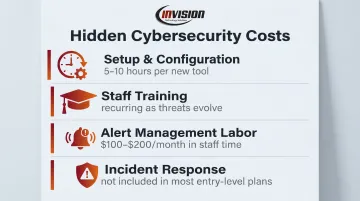
Tool subscriptions are only part of the picture. Setup time, staff training, and ongoing management add real cost. Budget planning needs to account for total cost of ownership, not just the monthly invoice. Hidden costs typically include:
- Setup and configuration time — often 5–10 hours per new tool
- Staff training — recurring as tools update and threats evolve
- Alert management labor — a tool requiring 2 hours/week costs roughly $100–$200/month in staff time at typical wages
- Incident response — not included in most entry-level or mid-range setups
Key Factors That Affect Your Cybersecurity Costs
Number of Endpoints and Employees
Most security tools price per user or per device. A 5-person business and a 30-person business using identical tools face very different bills.
Remote and hybrid workers compound this — each employee typically introduces multiple endpoints (laptop, phone, tablet), and only 27% of organizations report full visibility into remote employee activity. Every additional endpoint requires licensing, monitoring, and patch management.
Industry and Compliance Requirements
Businesses in regulated industries face mandatory security controls that go beyond baseline protection:
- Healthcare and dental (HIPAA): Compliance costs range from $5,000–$25,000/year for small practices, covering risk assessments, encryption, audit logging, and workforce training. HIPAA penalties start at $141 per violation and can reach $2.13 million annually for willful neglect.
- Financial services (PCI DSS, SOX, GLB): PCI DSS non-compliance can trigger fines of $5,000–$100,000/month.
- Legal firms: Client data confidentiality obligations create strong security requirements even without formal regulatory mandates.
Phoenix Metro businesses in healthcare, dental, and financial services — industries InVision Technology Solutions specifically supports — need to budget compliance spending as a dedicated line item from the start.
DIY Tools vs. Managed Security Services
Choosing between DIY tools and managed services comes down to more than subscription cost — it's about capability and internal capacity:
| Factor | DIY Tool Stack | Managed Services |
|---|---|---|
| Monthly cost (25 users) | $300–$800 in subscriptions | $1,125–$3,000 |
| Monitoring | Manual, business hours only | 24/7 automated + human response |
| Staff time required | 5–15 hours/month | Near zero |
| Incident response | DIY or expensive hourly consultant | Included |
| Expertise required | High | None in-house needed |
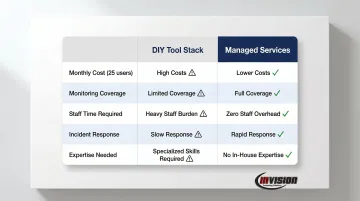
For businesses without dedicated IT staff, managed services frequently cost less once internal labor is properly accounted for.
Current Risk Exposure and Threat Profile
Businesses that store payment data, medical records, or sensitive customer information carry more risk — and typically need stronger controls. A basic risk assessment (typically $1,500–$5,000 for businesses under 100 employees) helps calibrate the investment before committing to a security stack.
Budget vs. Premium Cybersecurity: What's the Real Difference?
Budget and premium cybersecurity tools differ in one critical dimension: how fast a threat gets detected and contained — and that gap has a direct dollar value.
Detection Speed and Cost
IBM's 2025 Cost of a Data Breach Report found that breaches contained in under 200 days cost an average of $3.87 million, while those exceeding 200 days averaged $5.01 million — a $1.14 million difference tied entirely to detection speed.
Budget/DIY tools alert after a threat is detected. Managed/premium solutions monitor continuously and often contain threats before damage spreads. Without 24/7 monitoring, small businesses may not detect a breach for weeks — by which point recovery costs have compounded significantly.
Management Burden
Low-cost tools require internal staff to configure, update, and act on alerts. For businesses without IT staff, this means the business owner or an office manager is making security decisions, typically without the expertise to do so effectively.
Managed services absorb this burden entirely. InVision's InWatch system, for example, covers servers, desktops, laptops, and network devices with a 5-minute average response time — no internal IT staff required.
Key differences in what each approach covers:
- Budget tools: Reactive alerts, manual configuration, owner-managed updates
- Managed services: 24/7 proactive monitoring, automatic threat response, dedicated engineering support
Long-Term Value
The cost of underinvesting becomes clearer when you look at attack patterns. Ransomware appears in 88% of small business breaches according to Verizon DBIR 2025, compared to just 39% for large organizations. Attackers target small businesses specifically because they expect faster payouts and weaker defenses. A single ransomware incident costing $120,000–$1.24 million can dwarf multiple years of premium security investment.
How to Estimate the Right Cybersecurity Budget for Your Business
Step 1 — Start With a Risk and Asset Inventory
Identify what data you hold (customer records, payment info, medical records), which systems are critical, and where the biggest vulnerabilities are. This prevents spending on protections that don't match actual risk. InVision offers a free network security assessment to help Phoenix Metro businesses do exactly this — before committing to any solution.
Step 2 — Prioritize High-Impact, Lower-Cost Controls First
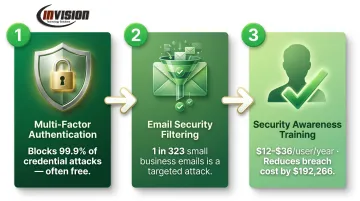
Three controls deliver the most risk reduction per dollar spent:
- MFA: Microsoft research confirms MFA blocks over 99.9% of account compromise attacks, and credential abuse drives 22% of all breaches. It's often free or included in existing software licenses.
- Email security filtering: Phishing is the most common attack vector, and 1 in every 323 emails at small businesses is a targeted malicious attack.
- Security awareness training: Costs $12–$36 per user per year and reduces average breach costs by $192,266 according to IBM's 2025 report.
Step 3 — Account for Total Cost of Ownership
Budget planning must include:
- Setup and implementation costs
- Staff time for ongoing management
- Periodic training updates
- Incident response costs (if not covered by a managed plan)
These hidden costs often add 30–50% on top of the base subscription price — worth factoring in before you commit.
Step 4 — Consider a Managed Services Partner for Predictable Coverage
For small businesses without a dedicated IT team, a local managed IT and security provider handles monitoring, patching, and incident response — so you're not piecing it together on your own. InVision Technology Solutions has served Phoenix Metro businesses since 2006, holding Microsoft Silver Technology Partner and Select Certified Cisco Partner certifications.
InVision's tiered managed service plans (Basic, Bronze, Silver, Platinum) include 24/7 monitoring with predictable, upfront pricing and no long-term contracts required.
What Most Small Businesses Get Wrong About Cybersecurity Costs
Most small businesses underestimate what cybersecurity actually costs — and what it costs not to have it. Here are the four mistakes that consistently derail SMB security budgets:
Tool price only, not management cost. The cheapest tools require the most internal oversight. Every unreviewed alert is an open risk. Factor management time into every purchasing decision.
Ignoring breach recovery costs. The Verizon DBIR 2025 puts the low end of an SMB breach at $120,000 — and operational downtime alone averages $53,000 per hour. A proactive security stack for a 25-person business runs $36,000–$50,000 per year. A single breach costs more than two years of full protection.
Assuming small size means low risk. Small businesses are three times more likely to be targeted than large companies. Cybercriminals specifically seek out weaker defenses — your size is an advantage for attackers, not a shield.
Skipping employee training to cut costs. 60% of breaches involve the human element. Security awareness training runs $12–$36 per user per year — among the cheapest, highest-impact investments available. Leaving employees exposed to phishing to save a few hundred dollars is a trade-off that rarely ends well.
Conclusion
Cybersecurity costs for small businesses vary widely — from under $500/month for basic DIY setups to $3,000+ for comprehensive managed protection. The right budget isn't the cheapest or the most expensive; it's one matched to your actual risk, your compliance obligations, and your capacity to manage security in-house.
A practical starting point for most small businesses:
- Enable MFA across all accounts and email systems
- Add email filtering and endpoint protection
- Run at least annual employee security training
- Set up automated, offsite backup
Once those layers are in place, evaluate whether a managed services partner makes more sense than handling security internally. For most small businesses without dedicated IT staff, it does — a local provider like InVision Technology Solutions can monitor your network 24/7, respond within minutes, and scale coverage as your business grows. Start with one step, then build from there.
Frequently Asked Questions
How much does cybersecurity cost for a small business?
Monthly costs range from under $500 for basic DIY setups to $1,125–$3,000+ for managed security services. The variables are company size, industry compliance requirements, and whether you manage tools internally or outsource to a provider.
What are the best budget-friendly cybersecurity solutions for a small business?
MFA, email security filtering, endpoint protection, and a password manager offer the strongest risk reduction at the lowest cost. These four controls should be in place before adding anything else to the security stack.
Can a small business handle cybersecurity without a dedicated IT team?
Free and low-cost tools exist, but managing them effectively requires time and security expertise most small businesses don't have. See the managed vs. DIY question below for a full cost comparison.
What cybersecurity solutions should a small business prioritize first?
MFA, email security, endpoint protection, and employee training address the most common attack vectors — phishing and credential theft — at manageable cost. Start here before evaluating anything else in the security stack.
Is managed cybersecurity more cost-effective than DIY tools for small businesses?
For businesses without dedicated IT staff, yes. DIY tools carry hidden costs in staff time, missed alerts, and slower incident response. Managed services provide 24/7 monitoring and expert response at a predictable monthly fee — and that fee usually wins when all internal labor costs are counted.
What happens if a small business skips cybersecurity investment entirely?
Recovery costs — downtime, data loss, legal fees, and reputational damage — typically start at $120,000, far exceeding a full year of proactive security investment. Unprotected businesses also face regulatory penalties if they operate in compliance-sensitive industries.