The challenge for most businesses isn't recognizing that disaster recovery matters. It's figuring out what to actually spend — and on what.
Disaster recovery service costs vary dramatically based on business size, recovery speed requirements, data volume, industry compliance obligations, and whether you're managing infrastructure in-house or outsourcing to a managed provider. That variability causes two common mistakes: underprotection from choosing too little, or wasted spend from choosing the wrong configuration entirely.
This guide breaks down realistic pricing tiers, the key factors that drive costs up or down, what you're actually paying for inside a DR contract, and how to budget without leaving your business exposed.
Key Takeaways
- Managed DRaaS costs range from $500–$1,500/month for small businesses up to $10,000–$50,000/month for enterprise environments
- RTO and RPO targets are the single biggest cost drivers — the faster you need to recover and the less data loss you can tolerate, the more you pay
- Hidden costs like downtime losses, compliance fines, and reputational damage typically dwarf the cost of the recovery solution itself
- In-house DR typically costs 3x more than managed DRaaS over a multi-year period, based on industry cost analyses
- A tested, managed DR plan is a business survival investment — treat it as a core operational cost, not an optional IT line item
How Much Do Disaster Recovery Services Cost?
Disaster recovery doesn't have a single price tag. Costs vary based on whether you choose an in-house setup, cloud-based solution, or fully managed DRaaS — and within each model, they scale with the size and complexity of your environment.
Here's a realistic breakdown by business tier, based on industry pricing data from IT Vortex:
Entry-Level: Small Business (Under 50 Users)
Typical monthly cost: $500–$1,500
At this tier, you're generally getting:
- Basic cloud backup with scheduled replication
- Standard SLA guarantees (typically 4–8 hour RTO rather than near-zero)
- Limited VM coverage for core systems
- One-time setup fees in the $2,000–$5,000 range
Not included at this price point:
- Compliance reporting (HIPAA, SOX) — typically a $500–$1,500/month add-on
- Real-time or continuous data protection
- Dedicated DR engineering staff
- Advanced failover testing beyond basic validation
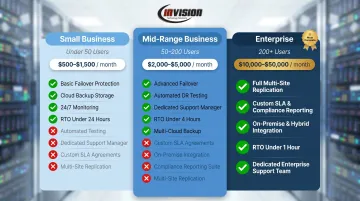
This tier works for businesses with low data sensitivity and some tolerance for downtime. If you're in a regulated industry — healthcare, legal, finance — or running mission-critical applications, you'll need more than this tier provides.
Mid-Range: Growing Business (50–200 Users)
Typical monthly cost: $2,000–$5,000
At this scale, you get meaningfully more protection:
- Broader VM coverage across multiple servers
- More frequent backup intervals (hourly or near-hourly)
- Higher storage allocations
- Managed failover and monitoring
- Basic SLA guarantees with defined RTO/RPO targets
Common gaps at this tier:
- Industry-specific compliance documentation and audit support
- Dedicated named DR engineers
- Encrypted replication as a standard feature (often a $500–$2,000 add-on)
- Complex multi-site failover configurations
This is the right tier for businesses with moderate downtime tolerance, growing data volumes, and some compliance exposure.
Enterprise: Large or Complex Environments (200+ Users)
Typical monthly cost: $10,000–$50,000
Enterprise DR involves protecting hundreds of virtual machines, mission-critical applications, and complex infrastructure — often with near-zero RTO/RPO requirements. Per-server pricing typically runs $50–$250/server/month, with most vendors requiring a full environment assessment before quoting a final number.
Enterprise solutions commonly bundle:
- Real-time replication and continuous data protection
- Dedicated support teams and named account management
- Compliance frameworks (HIPAA, SOX, PCI DSS)
- Geographic redundancy across multiple data centers
- Advanced monitoring and automated failover capabilities
Getting accurate quotes at this level means sharing specifics: VM count, application criticality, compliance requirements, and acceptable downtime thresholds. The more detail you bring to that conversation, the more accurate the pricing.
Key Factors That Affect the Cost of Disaster Recovery Services
No two DR environments cost the same. Pricing is shaped by a combination of technical requirements and business-specific factors — here are the ones that have the biggest impact on your budget.
Recovery Time Objective (RTO) and Recovery Point Objective (RPO)
RTO measures how fast your systems must come back online after a failure. RPO measures how much data loss you can tolerate, expressed in time.
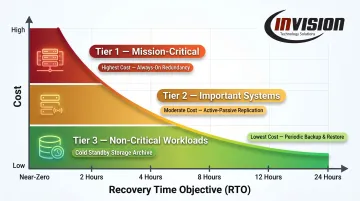
These two metrics are the primary drivers of DR cost — and the relationship is not linear. A near-zero RTO requires hot standby servers running continuously, synchronized in real time. A 24-hour RTO can use cold or warm standby infrastructure that only spins up when needed — at a fraction of the cost.
Similarly, a tight RPO (say, 15 minutes) requires continuous data protection with high bandwidth and constant storage writes. A 24-hour RPO requires only daily backups.
The practical approach is workload tiering: classify systems by criticality and apply aggressive RTO/RPO targets only to mission-critical workloads. Tier 2 systems typically carry 2–8 hour RTO and up to 24-hour RPO — at significantly lower cost than blanketing everything at the same protection level.
Business Size and IT Infrastructure Complexity
The number of servers, virtual machines, workstations, applications, and branch locations you need to protect determines scope — and scope determines price. A 10-person firm with one server has fundamentally different needs than a 100-employee company with multiple locations and an ERP system.
Every additional system added to protection scope increases storage, replication bandwidth, and management overhead. That complexity compounds quickly as businesses grow.
Data Volume and Storage Requirements
Cloud storage pricing varies enormously depending on access frequency:
| Storage Tier | Cost per GB/Month |
|---|---|
| AWS S3 Standard | $0.023 |
| Google Cloud Nearline | $0.010–$0.015 |
| Google Cloud Archive | $0.0012 |
| Azure Hot Tier | $0.18 |
| Azure Cold/Archive Tier | $0.002 |
| Managed DRaaS (bundled) | $0.02–$0.10 |
That 90x difference between Azure hot-tier and cold-tier storage means data volume decisions directly impact your monthly bill. Medical practices with DICOM imaging files, law firms with large document archives, and manufacturers with CAD/CAM databases need to model storage growth carefully — costs compound quickly at scale.
Data egress fees add another layer. AWS charges $0.09/GB for internet-bound transfers, which can become a meaningful cost during an actual failover event.
Industry Compliance Requirements
Regulated industries don't get to treat DR as optional. HIPAA's Security Rule (Section 164.308) explicitly mandates data backup plans, disaster recovery plans, and emergency mode operation plans. Non-compliance penalties reach up to $2,190,294 per violation for willful neglect — a figure that reframes even enterprise-level DR spending.
Recent enforcement illustrates the real stakes:
- Solara Medical Supplies: $3,000,000 settlement (2025) for risk management failures
- Montefiore Medical Center: $4,750,000 settlement (2024) for Security Rule violations
- USR Holdings: $337,750 penalty (2025) for lacking retrievable ePHI procedures
Financial firms under SOX face organizational penalties up to $2,000,000. The cost of compliance add-ons ($1,000–$3,500/month) looks different when measured against those enforcement outcomes.
Deployment Model: In-House vs. Managed DRaaS vs. Hybrid
| Factor | In-House DR | Managed DRaaS | Hybrid |
|---|---|---|---|
| Upfront cost | High (CapEx-heavy) | Low (setup fee only) | Moderate |
| Ongoing cost | High (staff, refresh cycles) | Predictable monthly fee | Mixed |
| Recovery speed | Depends on internal expertise | Provider-guaranteed SLAs | Varies |
| Staffing burden | Heavy | Minimal | Moderate |
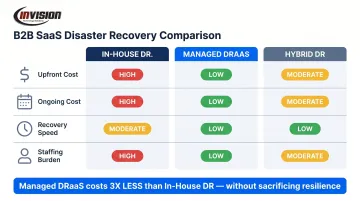
In-house maintenance alone typically consumes 15–25% of hardware purchase price annually. IBM benchmarks put in-house DR at roughly 3x the cost of managed DRaaS over a multi-year period. That gap reflects capital investment, staffing, and hardware refresh cycles that effectively double costs each time production infrastructure is upgraded.
Cost Breakdown: What You're Actually Paying For
A DR subscription or hardware budget isn't the whole picture. Here's where money actually goes:
Setup and Onboarding
One-time setup covers initial configuration, data migration, system integration, and DR plan documentation. Expect:
- Small business: $2,000–$5,000
- Mid-sized business: $5,000–$10,000
- Enterprise: $10,000–$15,000
Some managed providers include onboarding in the contract; others bill it separately. Confirm this upfront.
Recurring Subscription or Management Fees
This is the ongoing monthly cost covering managed DR infrastructure, monitoring, updates, and support. Pricing scales based on:
- Number of protected systems (servers, endpoints, applications)
- Storage volume included in the plan
- SLA tier — faster recovery time objectives cost more
- Support level — 24/7 monitoring vs. business-hours-only coverage
For most DRaaS clients, this recurring fee is the largest line item in the DR budget.
Storage and Data Transfer Costs
Cloud-based DR solutions charge separately for:
- Storage: Per GB/month based on tier
- Data egress: $0.09–$0.20/GB when data is restored or transferred
For data-heavy organizations, these charges can rival the subscription fee if not accounted for in the budget.
Testing, Maintenance, and Plan Updates
Regular testing is what separates a working DR plan from a false sense of security. Failover testing costs $500–$2,000 per test instance, though some managed providers include basic testing in the subscription. As your IT environment evolves (new applications, staff changes, infrastructure upgrades), the plan itself requires updates to remain effective.
In-House DR vs. Managed Disaster Recovery — What's the Real Cost Difference?
IBM states it plainly: owning and managing your own DR site costs approximately three times as much as using DRaaS. The gap comes from factors that don't show up in a hardware quote.
In-house DR carries costs that compound over time:
- Capital expenditure: Servers, networking hardware, and secondary data center space paid upfront
- Ongoing staffing: Dedicated personnel to manage and maintain DR systems
- Parallel upgrades: Every production infrastructure upgrade requires a matching DR upgrade, effectively doubling the cost
- Continuous depreciation: Assets lose value while still demanding investment to stay current
Managed DRaaS flips this model entirely. The provider absorbs infrastructure costs, handles upgrades, and delivers guaranteed SLAs without requiring internal expertise. For businesses without dedicated IT departments, this translates to both lower costs and stronger reliability.
For Phoenix Metro businesses in healthcare, legal, finance, or manufacturing — where data compliance and uptime requirements are strict — that cost predictability matters as much as the protection itself. InVision Technology Solutions provides managed DR services with proactive monitoring, compliance-aware configurations, and transparent pricing built around the specific needs of Arizona businesses.
What Most People Miss When Budgeting for Disaster Recovery
The subscription fee is the easy part of the budget. These three blind spots are where businesses get hurt:
1. The Real Cost of Downtime Is Rarely in the Budget
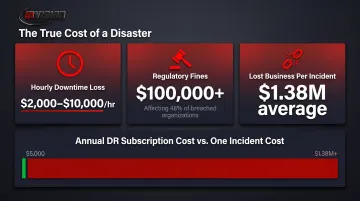
Direct losses for SMBs run $2,000–$10,000 per hour during an outage. A few hours of downtime can exceed an entire year of DR subscription costs. Factor in regulatory fines — which top $100,000 for 48% of breached organizations — and lost business averaging $1.38 million per incident, and the true cost of a disaster is often 10x what the recovery solution would have cost.
2. Backup Tools and DR Solutions Are Not the Same Thing
A backup tool stores copies of data. A DR solution restores business operations — systems, applications, network access, everything. Research from Secureframe shows that 58% of data backups fail during actual recovery attempts, and 71% of organizations skip failover testing (simulating an actual system failure) entirely. An untested plan provides no reliable protection when it counts.
3. Compliance Requirements Determine What "Good Enough" Actually Means
Healthcare practices, dental offices, law firms, and financial services companies in Arizona face mandatory DR documentation and testing standards. A low-cost backup tool may not qualify under HIPAA or SOX frameworks — the apparent savings often generate legal exposure that costs far more to fix. DR solutions built for regulated industries treat compliance as a core requirement, not a feature bolted on after the fact.
Conclusion
Disaster recovery costs range from a few hundred dollars a month for a basic small business setup to tens of thousands for enterprise environments with near-zero downtime requirements. The right choice isn't the cheapest option — it's the configuration that matches your actual risk tolerance, recovery objectives, and compliance obligations.
For Phoenix Metro businesses in healthcare, legal, financial, or manufacturing sectors, that means working with an IT partner who understands both the technical requirements and the regulatory landscape specific to Arizona.
InVision Technology Solutions has been serving businesses across Scottsdale, Phoenix, Chandler, Mesa, and surrounding areas for 20 years — delivering managed backup and disaster recovery with 24/7 monitoring, compliance-aware configurations, and pricing that's transparent before you sign anything.
Ready to figure out what DR coverage actually makes sense for your business? Call (480) 699-8077 or visit InVision Technology Solutions to start the conversation.
Frequently Asked Questions
How much does disaster recovery as a service cost?
DRaaS typically costs $500–$1,500/month for small businesses, $2,000–$5,000/month for mid-sized organizations, and $10,000–$50,000/month for enterprise environments. Cost scales with the number of protected systems, storage volume, and how quickly you need to recover.
Can a small business use a disaster recovery plan?
Yes — and it's one of the smarter investments a small business can make. Managed DRaaS options start around $500/month, and that cost is a fraction of what recovery looks like after a major data loss event without a plan in place.
What's the difference between RTO and RPO?
RTO is the maximum acceptable time before systems must be restored after a failure. RPO is the maximum acceptable data loss measured in time (for example, you can tolerate losing up to 4 hours of data). Tighter targets on either metric increase DR costs fast.
What is the difference between backup and disaster recovery?
Backup stores copies of your data. Disaster recovery is the full plan and infrastructure required to restore business operations — including systems, applications, and network access. Backup alone doesn't guarantee fast recovery; 58% of backups fail during actual recovery attempts.
Is disaster recovery required for compliance in regulated industries?
Healthcare (HIPAA), finance (SOX, PCI DSS), and legal sectors all operate under regulatory frameworks requiring documented DR plans, regular testing, and data protection measures. Non-compliance penalties can reach into the millions per violation.
How often should a disaster recovery plan be tested?
At minimum annually, with semi-annual or quarterly testing recommended for mission-critical systems or regulated environments. Any significant IT change — new applications, infrastructure upgrades, staff turnover — should also trigger a plan review.