Introduction
If you're building a healthcare SaaS product, you've probably searched "how much does HIPAA compliance cost" and found estimates written for hospital systems with dedicated compliance teams and seven-figure IT budgets. Those numbers don't translate to a 12-person startup trying to close its first enterprise health plan deal.
The stakes are real. U.S. digital health startups raised $14.2 billion in 2025 — a 35% jump over 2024 — and OCR enforcement hasn't slowed to match. As of late 2024, OCR had settled or imposed civil money penalties in 151 cases totaling over $143 million, including cases against software companies acting as business associates.
HIPAA compliance costs for SaaS startups vary significantly based on funding stage, PHI volume, existing security maturity, and whether you build in-house or use external support. Knowing where your startup falls on that spectrum is what makes the difference between a realistic budget and a costly surprise.
This article breaks down realistic cost ranges by stage, itemizes what each dollar buys, maps a practical compliance timeline, and flags the mistakes founders make most often.
Key Takeaways
- Year-one HIPAA compliance costs range from $8,000–$25,000 for small practices to $85,000–$250,000+ for mid-size and multi-location organizations
- Key cost drivers: PHI volume, staff size, existing security controls, and whether you use in-house or managed compliance support
- Ongoing annual spend typically runs 30–60% of year-one costs — compliance is a program, not a project
- Timeline to baseline compliance: 4–12 weeks; full audit readiness adds 3–6 more months
How Much Does HIPAA Compliance Cost for SaaS Startups?
HIPAA compliance has no fixed price tag. Costs are driven by what data you handle, how many systems touch it, and what level of assurance your customers demand.
Three mistakes tend to blow up compliance budgets before they start:
- Treating compliance as a one-time project rather than an ongoing program — founders who plan a single "compliance sprint" end up doing expensive retroactive work when an investor or enterprise customer asks for evidence
- Getting blocked mid-sales cycle because documentation and controls weren't ready when the enterprise security review landed
- Overspending on GRC tooling that a 10-person team will never fully use — compliance automation platforms make sense when a real sales motion requires third-party proof, not in anticipation of it
Pre-Seed Stage (1–10 Staff)
Typical year-one cost: $8,000–$25,000
At this stage, you're building the foundation. Published benchmarks from AccountableHQ's 2026 pricing breakdown place small organizations (1–50 staff) at $6,000–$35,000 initial, which supports this range.
That budget typically covers:
- HIPAA risk analysis and gap assessment
- Core policy set (privacy, security, breach notification)
- MFA and access control configuration
- Business Associate Agreements (BAAs) with PHI-touching vendors
- Basic workforce training
Not included at this stage: third-party audits, compliance automation platforms, advanced GRC tooling, or penetration testing.
Seed Stage (11–50 Staff)
Typical year-one cost: $25,000–$85,000
Increased headcount and more complex architectures push costs up. This is also the stage where enterprise customer requirements first appear — and healthcare buyers increasingly require both HIPAA compliance and SOC 2 Type II before signing.
Budget at this stage typically includes:
- Formal security policies and documented procedures
- Employee training programs with tracking
- Initial vendor risk management process
- SOC 2 Type II readiness work (if enterprise sales are active)
- First external compliance review or gap assessment
Growth Stage (51–200 Staff)
Typical year-one cost: $85,000–$250,000+
At this stage, compliance becomes a dedicated function rather than a shared responsibility. Budget toward the upper end if any of these apply:
- Multi-cloud environments with complex data flows
- Multiple product lines touching different PHI categories
- Enterprise customers requiring HITRUST R2 certification
- Dedicated compliance officer or vCISO engagement
- Recurring external audits (annual or semi-annual)
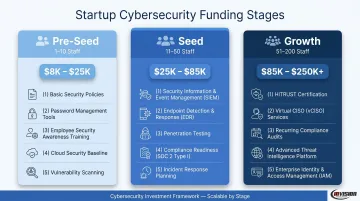
The wide cost range reflects how quickly advanced tooling, audit fees, and headcount compound. Knowing your stage costs is one part of the picture — understanding what drives timelines is the other.
Key Factors That Drive Your Actual Number
Your startup's stage gives you a rough anchor. Three operational variables determine where within that range you'll actually land.
PHI Volume and Architectural Complexity
The more ePHI your system stores, processes, or transmits — and the more microservices, APIs, and third-party integrations that touch it — the more controls, BAAs, and monitoring you need. Complexity compounds cost fast. Key architectural factors that drive your number higher include:
- More microservices and APIs that touch ePHI data flows
- Multi-tenant architectures with shared infrastructure
- Legacy data pipelines requiring retroactive mapping
- Third-party integrations needing individual BAAs
A greenfield single-tenant SaaS product is considerably cheaper to harden than a multi-tenant platform with legacy data pipelines.
The pending HIPAA Security Rule update (published in the Federal Register in January 2025) would formally require technology asset inventories and ePHI flow mapping, which will only increase the cost differential between simple and complex architectures.
Existing Security Maturity
Startups with MFA enforced, centralized identity management, and basic logging already in place spend less on remediation than teams starting from scratch. The fixed costs — risk analysis, policy development, training — don't disappear with existing controls, but tooling and remediation costs drop considerably.
Internal vs. External Compliance Support
DIY compliance typically requires 80–200 hours of internal work for a lean startup program. That's not a trivial time cost for a founding team. Options include:
- Fractional CISO or compliance consultant — reduces internal burden but adds external fees ($3,000–$15,000 for gap analysis and policy work)
- Managed IT service provider with healthcare experience — firms like InVision Technology Solutions can bundle 24/7 network monitoring, endpoint security, encrypted backup, and threat detection into predictable monthly costs, replacing several individual tool subscriptions
- Pure DIY — lowest dollar cost, but it trades external fees for founder hours and carries the highest risk of undocumented gaps
Complete HIPAA Compliance Cost Breakdown
HIPAA compliance cost is not a single line item. It's the sum of several distinct investment categories, each with one-time and recurring components.
| Category | Type | Cost Range |
|---|---|---|
| Risk assessment (third-party) | Recurring annually | $5,000–$20,000 |
| Policy and documentation | One-time + annual updates | $3,000–$15,000 (outsourced) |
| Workforce training | Recurring annually | $20–$60/user/year |
| Training management platform | Recurring | $3–$10/user/month |
| Identity/SSO/MFA | Recurring | $3–$10/user/month |
| Endpoint security and MDM | Recurring | $7–$20/endpoint/month |
| SIEM/log management | Recurring | $200–$2,500/month |
| Secure backups | Recurring | $100–$1,000+/month |
| Compliance automation platform | Recurring | $300–$2,000/month |
| BAA drafting and review | Per agreement | $500–$2,000 each |
| Legal/HIPAA counsel | Annual | $5,000–$25,000 |
| Penetration testing | Annual | $8,000–$25,000 |
| Voluntary third-party audit | As needed | $15,000+ |
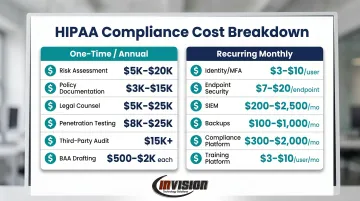
Three line items deserve closer attention:
Risk assessment is the single highest-ROI dollar you'll spend. OCR has an explicit "risk analysis enforcement initiative" — it's the most common Security Rule violation across resolution agreements, and BST & Co. CPAs paid $175,000 specifically for failing to complete one.
Policy documentation carries a hidden trap: buying a generic "HIPAA policy pack," swapping in your logo, and uploading it to a shared drive creates documented liability. If investigators find a gap between what your policies claim and what your product actually does, that gap can turn a compliance incident into a negligence finding.
Compliance automation platforms like Vanta (around $10,000/year) and Drata (costs around $7,500/year for smaller teams) are legitimate investments. The right trigger is an active enterprise sales motion that requires third-party proof — not speculative future demand.
HIPAA Compliance Timeline: How Long Does It Take?
Most healthcare and medical practices reach baseline HIPAA compliance within 3–6 months. The work breaks into three distinct phases — foundation, controls implementation, and audit readiness — each with specific deliverables that build on the last.
Phase 1: Foundation (Weeks 1–4)
What gets done:
- Map ePHI data flows across your entire stack
- Complete an initial risk analysis
- Draft the four foundational policies: access control, incident response, data handling, acceptable use
- Execute BAAs with all PHI-touching vendors
- Confirm encryption, logging, and backups are active on your infrastructure
Startups already using a managed IT partner with compliant infrastructure typically complete this phase faster — the monitoring, backup, and access control layers are already in place.
Phase 2: Controls Implementation (Weeks 4–8)
What gets done:
- Deploy MFA and centralized identity management
- Complete workforce training with tracked completion records — documented records are required evidence, not a formality
- Build a vendor inventory
- Implement vulnerability scanning and basic SIEM
- Document an incident response runbook
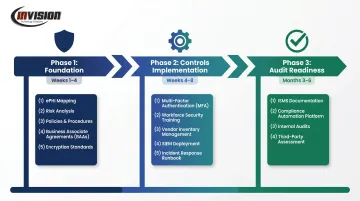
Phase 3: Audit Readiness (Months 3–6)
What gets done:
- Expand documentation into a full information security management system
- Add a compliance automation platform if enterprise customers are requiring SOC 2 alongside HIPAA
- Conduct internal audits and gap reviews
- Engage a third-party auditor for a voluntary readiness assessment
At this stage, healthcare customers — whether enterprise health systems or smaller specialty practices — typically ask for a signed BAA and evidence of a completed risk assessment. Enterprise buyers may also request a SOC 2 Type II report or HITRUST certification for higher-risk integrations.
Ongoing Annual Obligations
Reaching baseline compliance doesn't close the file. These obligations recur every year:
- Risk assessment refresh
- Workforce training updates
- Vendor inventory review
- Policy reviews
- Access control audits
- Incident response drills
Budget accordingly: annual maintenance typically runs 30–60% of your year-one investment. Building that number into your operational budget from the start prevents it from becoming a surprise line item.
What Most SaaS Founders Get Wrong About HIPAA Costs
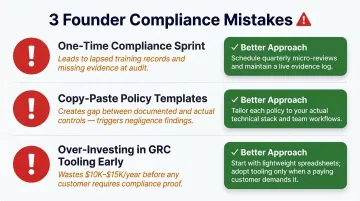
Three mistakes consistently inflate HIPAA costs — and all three are avoidable.
Treating compliance as a one-time project. Founders who plan a single compliance sprint end up facing expensive retroactive work — outdated policies, lapsed training records, missing evidence — right when an investor or enterprise customer asks for proof. OCR's enforcement data shows that documentation failures drive penalties more than technical gaps. The MMG Fusion case (a $10,000 settlement after a breach affecting 15 million individuals) came down to missing risk analysis and breach notification failures, not sophisticated technical flaws.
Copying policy templates without operationalizing them. The gap between written policy and real practice is a primary source of enforcement liability. If your policies describe encryption controls you haven't actually deployed, that's worse than having no policy — it becomes evidence of negligence rather than ignorance.
Over-investing in tooling before validating demand. Pre-revenue startups signing $10,000–$15,000/year GRC platform contracts — before any customer has asked for compliance evidence — waste money before proving the need. Sequence your investments instead: risk analysis and policies first (low cost, high regulatory value), then automation platforms once a sales deal actually requires third-party evidence.
Frequently Asked Questions
How much does HIPAA compliance cost?
Year-one costs range from roughly $8,000–$25,000 for small startups to $100,000+ for larger organizations. Ongoing annual costs typically run 30–60% of initial spend, making compliance a continuous budget line rather than a one-time project expense.
How do I get HIPAA compliance for a SaaS app?
Start with a risk assessment, then implement the required administrative and technical safeguards — encryption, access controls, audit logging. Create documented policies, execute BAAs with every vendor that touches PHI, and complete workforce training with tracked completion records.
Are health apps covered by HIPAA?
HIPAA applies when a health app is operated by or on behalf of a covered entity, or functions as a business associate processing PHI. General wellness apps without a provider relationship typically aren't covered, though the FTC's Health Breach Notification Rule (effective July 2024) does apply to many health apps outside HIPAA's scope.
Does HIPAA apply to small businesses?
HIPAA applies based on the type of data handled and your relationship with covered entities, not company size. A two-person SaaS startup handling ePHI for a healthcare provider faces the same requirements as a large enterprise — there's no small-business exemption.
Can I get a HIPAA certification for free?
There is no government-issued HIPAA certification. You demonstrate compliance through documented controls, completed risk assessments, and signed BAAs. Private certifications and readiness audits offered by vendors are paid services and don't grant immunity from OCR enforcement.
What are the HIPAA changes for 2025–2026?
The HIPAA Security Rule NPRM published January 6, 2025, proposes mandatory MFA, encryption at rest and in transit, annual penetration testing, and technology asset inventories. As of mid-2026, the final rule hasn't been published. Implement these controls now regardless — enterprise healthcare buyers already expect them.