The US healthcare IT software market reflects how seriously organizations are taking this challenge. According to Grand View Research's 2025 report, the market was valued at $166.83 billion in 2024 and is projected to grow at a 15.46% CAGR through 2030. That growth has produced a wide range of providers — from billion-dollar enterprise EHR platforms serving hundreds of hospital systems to regional managed service providers supporting individual clinics.
This guide profiles five leading healthcare IT solutions providers in the United States. Each was selected for market presence, service depth, compliance credentials, and demonstrated track record with healthcare clients. Whether you run a large health system or a three-physician specialty practice, the right partner exists — but finding it requires knowing what to look for.
Key Takeaways
- Healthcare IT providers range from enterprise EHR platforms to local managed service providers; organizational size and specialty determine the right fit
- Key evaluation criteria: HIPAA compliance, certifications, response time, service breadth, and healthcare client experience
- Epic, Optum, and Cognizant serve large health systems; athenahealth excels with ambulatory practices
- Phoenix Metro healthcare practices should consider InVision Technology Solutions for local IT support with a 5-minute average response time
- No single provider fits every practice; assess scalability, pricing transparency, and local support availability before committing
What Healthcare IT Solutions Actually Cover
Healthcare IT solutions are the technologies, platforms, and managed services that help clinical and administrative staff run secure, efficient, and compliant operations. Coverage typically includes:
- EHR systems and clinical application support
- Network infrastructure design and maintenance
- Cybersecurity and HIPAA compliance management
- Data analytics and reporting platforms
- Cloud services and storage
- End-user support and help desk
Provider types vary just as widely. On one end, enterprise platforms like Epic serve hundreds of major hospital systems. On the other, regional managed service providers support individual clinics and specialty practices that lack in-house IT staff but face the same compliance obligations as large organizations.
A 2025 study published in PMC found that the average US healthcare delivery organization has 22 third-party vendors with network access, but only 51.1% maintain a comprehensive vendor inventory and 60% don't routinely monitor third-party access to sensitive information.
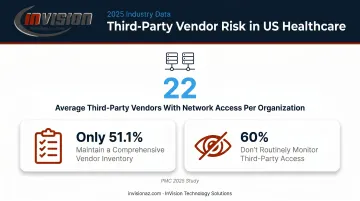
That gap between dependency and oversight is precisely where the right IT partner becomes essential.
The five providers profiled below were selected based on reliability, compliance capability, market presence, and demonstrated experience across different organization types and sizes.
Top Healthcare IT Solutions Providers in the United States
Epic Systems
Epic is a privately held, employee-owned company headquartered in Verona, Wisconsin, and the dominant enterprise EHR vendor in the US. Its platform currently holds electronic records for more than 325 million patients, making it the clinical IT backbone for a substantial portion of American healthcare.
What sets Epic apart is its end-to-end integration. Rather than stitching together separate vendors for billing, scheduling, and clinical documentation, Epic delivers all of this on a single platform — including its Care Everywhere interoperability network, which securely connects medical records across provider organizations. Its ongoing investment in AI-assisted documentation and predictive analytics has kept it at the top of KLAS rankings, most recently earning Best in KLAS recognition for Acute Care EHR (Large, 400+ Beds) in both the 2025 and 2026 reports.
| Category | Details |
|---|---|
| Key Services | Enterprise EHR, revenue cycle management, patient engagement portal (MyChart), telehealth, population health management, AI-assisted clinical documentation |
| Best For | Large hospitals, academic medical centers, and integrated health networks requiring a unified enterprise-scale clinical platform |
| Notable Strengths | ONC-certified EHR; Care Everywhere interoperability network; 2025 and 2026 KLAS Best in KLAS, Acute Care EHR Large |
Optum (UnitedHealth Group)
Optum is the health services and technology division of UnitedHealth Group, serving health systems, payers, employers, and government health programs with analytics, care management, pharmacy benefit management, and revenue cycle technology. Its competitive edge is data scale that no independent vendor can match.
Optum's EHR data covers more than 126 million unique lives, enriched with over 4.5 billion free-text medical notes processed with NLP. Its Optum Labs Data Warehouse encompasses more than 300 million de-identified lives across commercial claims, electronic medical records, and Medicare fee-for-service data. For health organizations that need to understand population health trends, reduce costs, or improve care delivery at scale, Optum's data infrastructure is hard to match.
| Category | Details |
|---|---|
| Key Services | Healthcare analytics (Optum Insight), clinical decision support, revenue cycle management, population health management, pharmacy benefit management |
| Best For | Health systems, payers, and large employer groups needing data-driven operational and clinical intelligence at enterprise scale |
| Notable Strengths | Division of UnitedHealth Group; one of the largest health data repositories in the US; maintained across multiple KLAS performance categories |
Cognizant
Cognizant is a global technology services company with a dedicated healthcare IT practice, serving hospitals, payers, and life sciences organizations with EHR implementation, revenue cycle automation, cloud migration, managed IT services, and AI-powered administrative solutions.
At the center of its healthcare practice is the TriZetto platform, which processes 2.6 billion transactions annually and supports 200 million+ lives. That transaction volume makes TriZetto one of the most widely used claims administration platforms in the US. Cognizant earned the #1 ranking in Claims and Administration Platforms (Payer) in both the 2025 and 2026 KLAS Best in KLAS reports — assessed across customer experience dimensions including operations, loyalty, product quality, and market energy.
| Category | Details |
|---|---|
| Key Services | EHR/EMR managed services, claims administration (TriZetto), revenue cycle management, cloud and infrastructure services, healthcare AI and analytics, cybersecurity |
| Best For | Large health systems, payers, and pharmacy benefit managers with complex, high-volume IT environments requiring enterprise-scale managed services |
| Notable Strengths | KLAS Best in KLAS #1, Claims and Administration Platforms (Payer), 2025 and 2026; TriZetto processes 2.6B transactions annually |
athenahealth
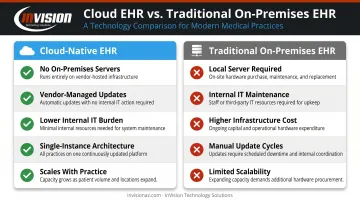
athenahealth is a cloud-native EHR, practice management, and revenue cycle services company headquartered in Boston, Massachusetts. Its platform, athenaOne, is delivered to 160,000+ ambulatory providers over a single-instance cloud architecture — no on-premises servers required.
That cloud-native model is what distinguishes athenahealth from most competitors. Practices offload billing, scheduling, and clinical documentation management to athenahealth's vendor-managed model, accessing enterprise-grade IT capability without building a large internal IT team. athenahealth won five 2026 Best in KLAS awards, including Ambulatory EHR (75+ Physicians), Behavioral Health EHR, and Overall Independent Physician Practice Suite — the latter for the third consecutive year.
| Category | Details |
|---|---|
| Key Services | Cloud EHR (athenaOne), revenue cycle management, practice management, patient engagement, AI-assisted clinical documentation |
| Best For | Ambulatory practices, specialty clinics, and mid-sized health systems seeking cloud-native managed IT with minimal internal IT infrastructure burden |
| Notable Strengths | ONC-certified cloud EHR; 5 Best in KLAS awards in 2026; Overall Independent Physician Practice Suite winner for third consecutive year |
InVision Technology Solutions
InVision Technology Solutions is a Scottsdale, Arizona-based managed IT services provider founded in 2006, serving healthcare organizations across the Phoenix Metro area for nearly 20 years. Its healthcare client base includes medical practices, dental offices, allergy clinics, and specialty providers — supported by certified expertise as a Microsoft Silver Technology Partner, Select Certified Cisco Partner, and Cisco Security Specialized provider.
For Phoenix-area healthcare practices, InVision offers something the enterprise platforms can't: a dedicated local team that knows your environment. Every client receives a primary and secondary systems administrator, a technical manager, and an account manager — so there's no explaining your setup from scratch every time something goes wrong. The company guarantees a 1-hour response time in writing, with an actual average response time of 5 minutes. Infrastructure reliability is backed by a 99.9% system uptime commitment.
The proof is in long-term relationships. Ania Leyko, MBA, Finance Manager at Allergy Asthma Clinic, Ltd — a Phoenix-area specialty practice and InVision client for over a decade — described the experience directly:
"Since we hired InVision Technology Solutions, over 10 years ago, we felt like we finally could focus entirely on patient care rather than being distracted by constant IT issues. They are reliable, professional and knowledgeable. Not only they address issues at hand, but they anticipate, prepare and address potential IT threats before they can hinder our operations."
No service commitment period is required across any managed service tier — a meaningful advantage for practices that have been burned by rigid contracts from larger vendors.
| Category | Details |
|---|---|
| Key Services | Managed IT services, 24/7 network monitoring (InWatch), cybersecurity, cloud services, VoIP, Microsoft 365 support, IT infrastructure management, HIPAA compliance support, EHR/EMR software support |
| Best For | Small to large healthcare practices and clinics in the Phoenix Metro area (Scottsdale, Phoenix, Tempe, Chandler, Gilbert, Mesa, Glendale) needing responsive local IT with HIPAA-aligned infrastructure management |
| Notable Strengths | Microsoft Silver Technology Partner; Select Certified Cisco Partner; Cisco Security Specialized; Certified Office 365 Provider; 5-minute average response time; 99.9% uptime; no service commitment required |
How to Evaluate Healthcare IT Providers
Most healthcare organizations make the same evaluation mistakes: prioritizing brand recognition over service fit, overlooking local support responsiveness, and accepting vague HIPAA compliance claims without verification. A well-known vendor name doesn't guarantee the right fit for your practice size or specialty.
The Core Evaluation Criteria
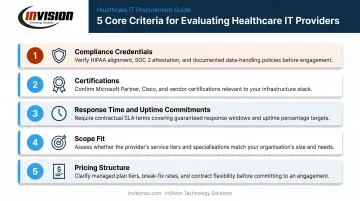
Before shortlisting vendors, evaluate each against these five criteria:
- Compliance credentials: Confirm the provider can execute Business Associate Agreements, support HIPAA security configurations, and show a track record with healthcare clients of your size and type — not just a checkbox claim.
- Certifications: Microsoft, Cisco, and ONC credentials signal verified technical competency. They also matter when you need vendor escalation and want a partner with actual standing.
- Response time and uptime commitments: Get both in writing as contractual SLAs. An advertised 5-minute response time is meaningless without defined remedies when uptime falls short.
- Scope fit: A large health system needs enterprise EHR, revenue cycle management, and population health analytics. A three-physician practice needs network monitoring, cybersecurity, EHR support, and someone who answers the phone. Mismatching scope is expensive.
- Pricing structure: Look for itemized, no-surprise pricing. Per-user/month, flat-fee managed services, and hybrid models all exist — the right structure depends on your team size and support volume.
Organizational Fit Matters More Than Brand
Once you've worked through those criteria, independent benchmarks can help narrow the field. KLAS Research recommends using Best in KLAS ratings as a starting point — not the final word. A top-ranked enterprise platform may earn a 90+ KLAS score across hundreds of large health systems while being completely impractical for a specialty clinic that needs a local engineer on-site within the hour.
Match the vendor to your actual operational model, not to a ranking built on a different type of organization.
Conclusion
The US healthcare IT market includes specialized providers at every scale — from enterprise EHR platforms and national managed services companies to local partners with deep knowledge of your region and specialty. The right fit depends on which provider's strengths align with your organization's clinical, administrative, and compliance needs.
Evaluate ongoing performance indicators over marketing claims: certified response times, uptime records, HIPAA compliance depth, and direct experience with organizations similar to yours. Those criteria are a useful starting point for any shortlist conversation.
Healthcare organizations in the Phoenix Metro area can find that combination in InVision Technology Solutions — a locally based managed IT partner with nearly 20 years of experience serving healthcare and medical clients, certified Microsoft and Cisco credentials, and a 5-minute average response time. Reach the team at 480-699-8077 or info@invisionaz.com.
Frequently Asked Questions
What does an IT solutions provider do?
An IT solutions provider manages and supports an organization's technology environment — covering infrastructure, cybersecurity, software systems, and end-user support — so internal staff can focus on core operations. In healthcare, this also includes ensuring compliance with regulations like HIPAA and supporting clinical systems such as EHRs.
What services do healthcare IT solutions providers typically offer?
Core offerings include managed IT infrastructure, EHR implementation and support, cybersecurity monitoring, cloud services, help desk, and backup/disaster recovery. Healthcare-specialized providers add HIPAA compliance management, patient data security, and medical device connectivity.
How do I choose the right healthcare IT provider for my practice?
Evaluate HIPAA compliance credentials, relevant certifications (Microsoft, Cisco, ONC), and experience with healthcare clients of similar size. Prioritize providers that offer transparent pricing, written response time commitments, and dedicated or local support — not a shared service pool where you explain your environment every time you call.
What is the difference between a healthcare IT solutions provider and an EHR vendor?
An EHR vendor (like Epic or athenahealth) provides the clinical software for documenting patient encounters. A healthcare IT solutions provider manages the broader environment those systems run on — networks, devices, security, cloud infrastructure, and end-user support.
Do small medical practices need a dedicated healthcare IT provider?
Yes. Small practices typically lack in-house IT staff but face the same HIPAA and cybersecurity obligations as large hospital systems. A managed IT partner delivers more predictable costs, faster issue resolution, and proactive threat prevention — compared to the reactive, break-fix approach most practices fall back on without dedicated support.
How much do managed IT services for healthcare typically cost?
Pricing depends on scope and model — per-user/month, flat-fee, or hybrid — with costs driven by user count, network complexity, and compliance requirements. Always request a detailed breakdown upfront and watch for hidden escalation fees.