
Introduction
Financial firms are facing a pressure cooker moment. Cybercriminals are deploying AI to scale attacks faster than security teams can respond. Regulators are adding new technical mandates with teeth. And fintech competitors are raising client expectations for digital experiences that most traditional firms can't yet match.
The result: IT spending in financial services is no longer discretionary. It's a core operating cost. How firms allocate those budgets in 2026 will separate those that thrive from those that scramble.
This article breaks down where financial IT dollars are flowing in 2026 — cybersecurity, AI, cloud infrastructure, client platforms, and managed services — and what's driving each shift.
Whether you're running a CPA firm in Scottsdale or managing IT for a regional financial advisory group, these trends will help you decide where to invest, what to defer, and where budget gaps are most likely to hurt.
Key Takeaways
- Cybersecurity now consumes 10.9%–12.4% of IT budgets in financial services — and growing
- AI is moving from experimentation to production, with fraud detection and security operations as the lead use cases
- Cost control now drives cloud strategy — migration is largely done
- Digital client platforms and operational resilience are now core budget lines, not nice-to-haves
- Talent shortages are driving small and mid-sized financial firms toward managed IT and security providers
Cybersecurity and Compliance: The #1 IT Budget Priority for Financial Firms
No other IT category attracts more financial services investment than cybersecurity — and the gap is widening.
According to Deloitte's financial services cybersecurity survey, financial institutions allocate roughly 10.9% of their IT budgets to cybersecurity, with IANS Research tracking that figure climbing toward 12.4% in 2025. Those numbers reflect a direct response to a measurably worse threat environment.
AI-powered phishing, deepfakes, and credential theft attacks now scale at machine speed. Financial firms are among the most targeted organizations globally — and the financial consequence of getting it wrong is severe. IBM's 2024 Cost of a Data Breach report puts the average breach cost in financial services at $6.08 million, second only to healthcare. For breaches involving 50 million or more records, that figure jumps to $375 million.
The Compliance Layer That Never Stops
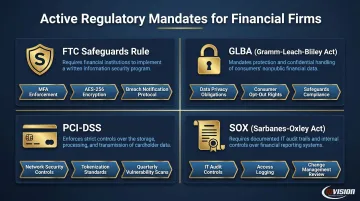
On top of the threat environment, financial firms in 2026 are simultaneously managing multiple active compliance mandates:
- FTC Safeguards Rule — Non-bank financial companies must maintain a qualified information security officer, implement MFA and encryption at rest and in transit, conduct annual penetration tests or continuous monitoring, and report breaches affecting 500+ consumers within 30 days (effective May 2024)
- GLBA — Ongoing data privacy and security program requirements for all financial institutions
- PCI-DSS — Technical controls for any firm processing card payments
- SOX — IT controls and audit trail requirements for publicly traded companies
Compliance is no longer a once-a-year project. It's an operational function that consumes engineering time, documentation effort, and tooling spend year-round.
That ongoing burden directly shapes where security budgets flow.
Where Security Spending Is Concentrating
Financial IT leaders are directing security budgets toward several specific categories:
- Identity Threat Detection and Response (ITDR) — Targeting credential abuse, a dominant attack vector
- AI-augmented SIEM and SOAR platforms — Handling higher alert volumes without scaling headcount at the same rate
- Endpoint Detection and Response (EDR) — Replacing legacy antivirus with behavioral monitoring
- 24/7 SOC coverage — Either built in-house or sourced through managed security providers
- Cloud and application security — Protecting APIs, cloud workloads, and non-human identities as cloud-native architectures expand
For accounting and financial advisory firms in the Phoenix Metro area navigating these same requirements, InVision Technology Solutions incorporates SOX, PCI-DSS, and GLBA compliance support into its managed IT service plans, including 24/7 network monitoring and client data encryption.
AI and Automation: Moving From Pilot to Production
A year ago, many financial firms had AI projects running in controlled pilots. In 2026, the serious ones are moving those systems into daily operations — and discovering that production AI is a fundamentally different investment than experimental AI.
McKinsey's 2025 State of AI survey found that 88% of organizations use AI regularly, but only about one-third have scaled it across the enterprise. Financial services firms are pushing harder than most sectors — 91% of financial institutions are using or planning to use cloud infrastructure specifically to support AI workloads, according to LSEG's 2025 global cloud survey.
The Three Use Cases Getting Budget
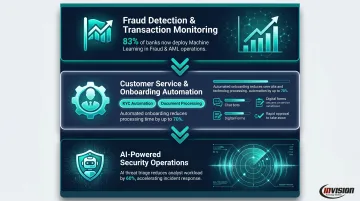
AI investment in financial services is concentrating around three areas:
- Fraud detection and transaction monitoring — Real-time pattern recognition that reduces false positives and flags anomalies faster than rule-based systems. In a 2024 financial crime survey by BioCatch, 83% of banks reported using machine learning in fraud and AML programs.
- Customer service and onboarding automation — Cuts manual document review, accelerates KYC processing, and handles routine client inquiries without adding headcount.
- AI-powered security operations — Automates threat investigation and triage so security teams handle higher attack volumes without scaling staff proportionally.
The Dual Cost of AI
AI creates budget pressure in two directions simultaneously — and most firms only budget for one.
Financial firms are investing in AI tools and in security controls to protect those AI systems. AI-specific vulnerabilities now require dedicated governance and security budget, including protections against:
- Model manipulation — attackers skewing outputs by corrupting inputs
- Data poisoning — corrupting training data to degrade model accuracy
- Adversarial inputs — crafted data designed to fool detection systems
The SEC's FY2025 examination priorities explicitly include scrutiny of whether firms' AI representations are accurate and whether policies adequately oversee AI usage in trading, fraud detection, and client record management.
Scaling AI in production also demands serious compute capacity — not just software licenses. That cost is increasingly showing up as a cloud infrastructure line item, which leads directly to cloud spending.
Cloud Infrastructure: From Migration to Efficiency
For most financial firms, cloud adoption is no longer the question. The question is: how do you run cloud environments efficiently enough to justify the spend — especially when AI workloads are inflating bills faster than anticipated?
82% of financial institutions now operate hybrid or multi-cloud environments, and 87% increased cloud spending over the prior two years, according to LSEG's 2025 survey. With Gartner forecasting worldwide public cloud spending at $723 billion in 2025, this is not a niche trend.
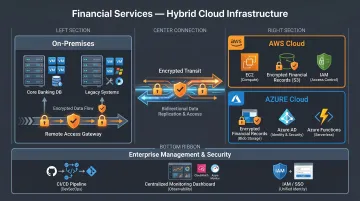
What Cloud Looks Like in Practice for Financial Firms
- Migrating legacy core systems to hybrid cloud environments while maintaining on-premises controls for regulated data
- Using Microsoft Azure and similar platforms for secure data storage, encrypted backups, and regulatory reporting
- Running cloud-native analytics for transaction monitoring, anomaly detection, and audit trail generation
- Supporting secure remote access for advisors, staff, and auditors
The Cost Optimization Problem
Cloud expansion has created a new headache: 84% of organizations struggle to manage cloud spend, per Flexera's 2025 State of the Cloud Report. For financial firms, AI-driven workloads are accelerating that cost pressure. Cloud cost management — FinOps practices, rightsizing, tagging, and governance tooling — now commands its own line in IT budgets, separate from the infrastructure it governs.
Security adds another layer of cost pressure. Cloud Security Posture Management (CSPM) tools are now standard budget items for financial firms in multi-cloud environments, driven by regulatory requirements around:
- Data residency and sovereignty
- Access controls and identity governance
- Audit logging and trail retention
Digital Client Platforms and Operational Resilience
Client expectations have shifted — and most of the pressure is coming from consumer fintech. When someone uses a well-designed personal finance app on Monday, they notice when their financial advisor's client portal feels like it was built in 2014 on Tuesday.
Financial advisory firms, accounting practices, and insurance providers are responding by investing in secure client portals, digital document exchange platforms, and mobile-accessible interfaces. These investments are measurable competitive advantages. According to J.D. Power's 2025 U.S. Wealth Management Digital Experience Study, firms with AI-enabled virtual assistants saw client satisfaction scores run 72 points higher for advised clients and 47 points higher for self-directed investors.
That same client-experience pressure is driving a parallel priority: keeping those systems available when it matters most.
Operational Resilience as a Budget Category
Operational resilience has moved from IT afterthought to board-level concern. Financial regulators are paying close attention:
- SEC FY2025 examination priorities explicitly include operational resiliency, business continuity planning, and incident response program readiness under amended Reg S-P
- FINRA's 2025 Annual Regulatory Oversight Report highlights Rule 4370 BCP compliance, third-party risk, and cyber-enabled fraud as examination focus areas
What firms are spending on to meet these expectations:
- Backup and disaster recovery (BDR) systems with tested recovery time objectives
- Redundant internet connectivity to prevent single points of failure
- Documented incident response plans — not just policies, but tested playbooks
- Third-party vendor risk assessments, given that supply chain attacks are rising
A single outage during tax season, a market event, or a compliance deadline doesn't just create operational disruption. It triggers client attrition, regulatory scrutiny, and reputation damage that compounds fast.
Managed IT Services: Why Financial Firms Are Outsourcing IT
The talent math simply doesn't work for most small and mid-sized financial firms trying to build internal IT teams.
According to ISC2's 2024 Cybersecurity Workforce Study, the global cybersecurity workforce gap stands at 4.8 million unfilled positions — a number that grew 19% year over year. Qualified security engineers command base salaries in the $110,000–$165,000 range, and that's before benefits, recruiting costs, and the reality that 51% of cybersecurity professionals report stress levels likely to push them toward leaving their current role.
For a 20-person accounting firm or a regional financial advisory practice, hiring two qualified IT and security professionals isn't just expensive — it's competing against enterprises with far larger compensation budgets.
What a Managed IT Model Actually Delivers
A well-structured managed IT engagement converts unpredictable IT risk into a controlled, predictable monthly expense. Specifically, firms get:
- Continuous network monitoring and threat detection — not just business hours, but around the clock
- Proactive patch management that closes vulnerabilities before attackers find them
- Compliance reporting support: documentation and controls that regulators actually want to see
- Engineers who know the firm's specific environment, software stack, and regulatory profile
- Predictable monthly costs instead of emergency repair bills that show up without warning
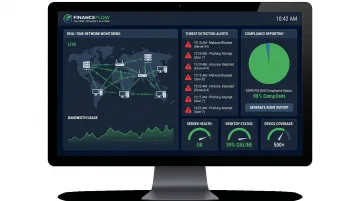
For accounting and financial firms in the Phoenix Metro area, InVision Technology Solutions operates on this model. Their InWatch monitoring platform covers servers, desktops, laptops, and network devices continuously, with two dedicated engineers assigned to each client account. They support compliance across SOX, PCI-DSS, and GLBA, and their average response time is around five minutes, with a guaranteed one-hour maximum for managed service clients.
The practical advantage of a local provider goes beyond cost — it's accountability. A Scottsdale-based firm that knows your environment, your compliance requirements, and your software stack (QuickBooks, Lacerte, Sage, Microsoft Dynamics) responds differently than a national vendor working from a ticket queue.
What's Driving These IT Budget Shifts — and What to Watch Next
Three forces are reshaping financial IT spending simultaneously, and they're not slowing down.
Escalating threat environment — AI-powered attacks are making traditional perimeter defenses obsolete. The economics are asymmetric: attackers use AI to launch thousands of targeted phishing campaigns at minimal cost, while defenders must detect and contain each one. At $6.08 million average breach cost in financial services, prevention investment looks cheap by comparison.
Regulatory pressure — The FTC, SEC, FINRA, and other regulators are mandating specific technical controls, not just general program requirements. The FTC Safeguards Rule now requires documented MFA implementation, encryption standards, and 30-day breach notification. SEC examiners are specifically reviewing AI governance, BCP documentation, and third-party risk oversight.
Fintech competitive pressure — Traditional financial firms are losing client experience ground to digital-native competitors. The J.D. Power data makes this concrete: digital experience gaps correlate directly with client satisfaction differences that drive switching behavior.
Forward-Looking Signals for 2026–2028
IT leaders planning budgets beyond the current year should track:
- AI in regulatory examinations — Regulators are using AI-assisted audit tools, requiring firms to maintain cleaner data governance, tighter audit trails, and more granular access logs
- Open banking API expansion — The CFPB's Section 1033 rulemaking is currently enjoined, but when it moves forward, firms will face new API security obligations for sharing financial data with third-party applications
- Third-party and supply chain risk — Nearly half of organizations experienced a third-party breach in the prior year; as financial firms add more cloud vendors and fintech integrations, this exposure grows in step
The firms that manage these pressures most effectively share one trait: they treat IT spending as a strategic function, not an emergency response. Aligning technology budgets with long-term risk management goals — rather than the last incident — is what separates firms that stay ahead from those that stay busy.
Frequently Asked Questions
What percentage of IT budget is spent on cybersecurity in financial services?
Financial services firms allocate roughly 10.9% to 12.4% of their IT budgets to cybersecurity, based on Deloitte's 2023 financial services survey and IANS Research 2025 benchmarks. That share has grown consistently year over year as both the threat environment and regulatory requirements have intensified.
What is the IT service budget for financial firms?
Financial services consistently ranks among the highest-spending sectors for IT, driven by compliance intensity and data sensitivity. Deloitte benchmarks cybersecurity spend alone at 0.48% of revenue — total IT spend varies by firm size and regulatory profile, but runs well above most other industries.
How is cloud computing used in financial services?
The most common use cases include:
- Hosting core banking and financial management platforms
- Enabling secure remote access for staff and advisors
- Storing and processing client data with encryption
- Running analytics and compliance reporting
Hybrid cloud models are most common among firms with data residency obligations or strict regulatory requirements.
What IT compliance requirements do financial firms face in 2026?
Most financial firms must comply with several overlapping frameworks:
- FTC Safeguards Rule — information security program requirements for non-bank financial companies
- GLBA — data privacy and security obligations
- PCI-DSS — card payment processing controls
- SOX — IT controls for publicly traded companies
Each requires ongoing investment and documentation, not a one-time setup.
Should financial firms outsource IT or build in-house teams?
Most small to mid-sized financial firms find managed IT services far more cost-effective than building internal teams. A managed provider delivers 24/7 monitoring, security expertise, and compliance support at a predictable monthly cost without the recruiting overhead or salary competition needed to retain scarce IT and cybersecurity talent.
How is AI changing IT spending in financial services?
AI is pushing spending in both directions. Firms are investing in AI-powered tools for fraud detection, workflow automation, and security operations — while simultaneously needing to budget for AI governance and security controls to protect against AI-enabled attacks. AI has become both a productivity investment and a new cost center within financial IT budgets.