The math simply doesn't work for most small and mid-size firms. Hiring, retaining, and continuously training IT professionals with both technical depth and financial industry knowledge is expensive. And one generalist IT employee rarely covers the full scope of what a compliance-conscious financial firm actually needs.
This guide breaks down why IT outsourcing is gaining traction across the financial sector, which services make the most sense to hand off, how compliance fits into the equation, and what the real cost comparison looks like between in-house IT and a managed services provider.
One data point worth noting upfront: the global BFSI outsourcing market was valued at $92.4 billion in 2024 and is projected to reach $192 billion by 2030 — with IT and infrastructure outsourcing holding the largest segment share. Financial firms aren't just dipping a toe in. They're all in.
Key Takeaways
- Banks spend nearly 70% of IT budgets maintaining legacy systems — outsourcing frees those resources for growth
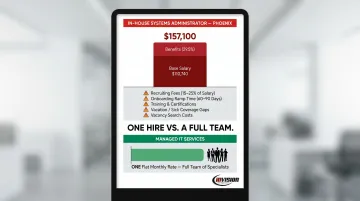
- A single in-house systems administrator in Phoenix costs $157,000+ annually when benefits are included
- Financial services data breaches average $6.08 million — managed cybersecurity reduces that risk without the cost of a full in-house security team
- The right MSP handles compliance requirements (GLBA, PCI DSS, SOX) as part of the engagement, not as an add-on
- Look for a provider with financial industry experience, fast response times, and transparent, no-lock-in pricing
Why Financial Services Firms Are Turning to IT Outsourcing
The Talent Gap Is Real, and It's Expensive
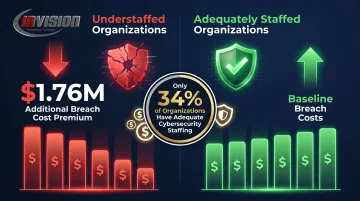
Finding IT professionals who understand both infrastructure and financial industry compliance requirements is hard. Only 34% of organizations report having adequate cybersecurity staffing, and budget constraints are the primary driver. For a small RIA, CPA firm, or regional lender, competing for that talent against larger institutions isn't realistic.
The shortage has a direct financial impact, too. Organizations with high-level security skills gaps experience breach costs $1.76 million higher than those without staffing issues — meaning the cost of not having skilled security personnel often exceeds the cost of outsourcing those functions.
Legacy Systems Are Draining Budgets
Banks and financial firms running on legacy infrastructure spend nearly 70% of their IT budgets on system maintenance — leaving almost nothing for system upgrades or new capabilities. Banking technology costs have also risen at roughly 4x the rate of banking revenue over the past 15 years.
Outsourcing gives firms a faster path out of that trap. Rather than rebuilding an internal team with the skills to manage a modernization project, an experienced MSP brings that expertise on day one.
The True Cost of In-House IT Goes Far Beyond Salary
Most financial firm principals think about IT headcount in terms of base salary. The real number is much higher. Benefits — health insurance, retirement contributions, payroll taxes, paid leave — add approximately 29.5% to the total employer cost, according to BLS Employer Costs data. Factor in recruiting, onboarding, ongoing training, and the productivity hit when that employee leaves, and you're well past salary.
A managed IT services model converts those unpredictable expenses into a flat monthly cost — a meaningful shift for firms with tight expense controls.
Scalability Without the Headcount Risk
Financial firms don't have uniform IT demands. Audit season, regulatory filing deadlines, and new product launches all create spikes in IT workload. An outsourced partner scales support up or down to match those peaks — without the disruption of emergency hiring or the cost of carrying excess capacity year-round.
That flexibility is part of what makes outsourcing practical for smaller firms. InVision Technology Solutions structures its service tiers so Phoenix Metro financial firms can adjust support levels as needs change — no long-term contracts required.
Key IT Services Financial Firms Should Outsource
Not every IT function needs to go external. The priority should be areas where specialized expertise, round-the-clock coverage, or advanced tooling is critical — and where the cost-to-value ratio strongly favors an external provider.
Managed IT Support and Help Desk
Day-to-day IT support — workstation issues, software troubleshooting, user onboarding and offboarding — consumes disproportionate internal time at financial firms. Staff who should be focused on client work end up troubleshooting printer connectivity or chasing password resets.
Outsourcing help desk to a provider with fast, guaranteed response times changes that dynamic. Response time is a critical evaluation criterion: InVision guarantees a 1-hour response time in writing for all managed service clients, with an actual average of 5 minutes in practice.
Cybersecurity Services
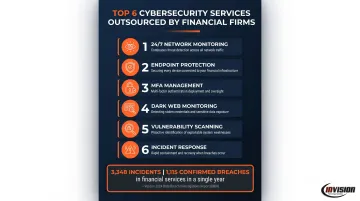
Financial firms are high-value targets. The services most commonly outsourced in this category include:
- 24/7 network monitoring and threat detection
- Endpoint protection (antivirus, malware prevention)
- Multi-factor authentication (MFA) management
- Dark web monitoring
- Vulnerability scanning
- Incident response planning and execution
This isn't optional coverage. Verizon's 2024 DBIR documented 3,348 security incidents and 1,115 confirmed breaches in financial services alone in a single year. A reactive, break-fix approach to security doesn't hold up against that volume of threats.
Cloud Solutions and Infrastructure Management
Outsourcing cloud migration and ongoing infrastructure management gives financial firms access to secure, scalable infrastructure without building it from scratch. Managed cloud services typically cover:
- Automated backups and data retention
- Virtual server management
- Disaster recovery with fast restoration times
- Encrypted data storage and transmission
One practical advantage: flat-rate managed cloud pricing from an MSP is far easier to budget around than the variable usage-based billing that comes directly from cloud vendors like AWS or Azure.
Compliance and Regulatory IT Support
That infrastructure has to meet strict regulatory requirements. Financial firms operate under overlapping frameworks — GLBA, PCI DSS, SOX, and SEC cybersecurity disclosure rules — each with specific IT controls that must be implemented and documented.
Outsourcing to an MSP with financial industry experience means working with a partner who already knows these standards, rather than relying on a general IT hire to interpret them on the fly. InVision's accounting and financial IT support covers SOX, PCI DSS, and GLB compliance requirements as part of its standard engagement scope.
Compliance and Cybersecurity: The Non-Negotiables
For financial services firms, a data breach isn't just an IT problem. It's a business-ending risk. The average breach in financial services costs $6.08 million, and even firms with fewer than 500 employees average $3.29 million per incident — a figure that would threaten the existence of most small or mid-size financial firms.
The Regulatory Landscape Financial IT Must Address
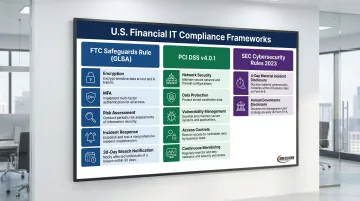
Three frameworks define the IT compliance baseline for most U.S. financial firms:
| Framework | Core IT Requirements |
|---|---|
| FTC Safeguards Rule (GLBA) | Encryption at rest and in transit; MFA; written risk assessment; incident response plan; breach notification within 30 days |
| PCI DSS v4.0.1 | Network security; data protection; vulnerability management; access controls; continuous monitoring |
| SEC Cybersecurity Rules (2023) | Material incident disclosure within 4 business days; annual risk management governance disclosure |
Meeting all three simultaneously requires documented policies, ongoing monitoring, access controls, and audit trail documentation — a full-time compliance workload that most small financial firms can't staff internally. That's where a compliance-ready managed IT partner changes the equation.
What a Compliance-Ready IT Engagement Looks Like
A properly structured managed IT engagement for a financial firm includes:
- Scheduled risk assessments covering internal and external threat vectors
- Security policies maintained and updated as regulations evolve
- Role-based user access controls limiting exposure across systems
- End-to-end encryption for data storage and transmission
- Audit trail documentation ready for regulatory review
An experienced MSP provides these as part of the managed services package — not as expensive add-ons billed separately.
Vendor Due Diligence Matters
Outsourcing IT doesn't transfer your compliance responsibility. Financial firms must evaluate any IT partner's own security posture before signing on. Key things to assess:
- Do they hold relevant certifications (SOC 2 Type II, Microsoft Partner status, Cisco Security Specialized)?
- Can they provide documentation of their security practices?
- Are they willing to sign a vendor agreement covering data handling and security?
- Do they have documented experience with financial industry compliance frameworks?
InVision Technology Solutions holds Microsoft Silver Technology Partner and Cisco Security Specialized certifications, and has worked directly with financial clients navigating SOX, PCI DSS, and GLBA requirements — so the compliance context isn't new territory for the team.
The Real Cost: IT Outsourcing vs. Keeping IT In-House
What One In-House IT Employee Actually Costs in Phoenix
Using Robert Half's 2026 salary data for Phoenix, a Systems Administrator commands a median base salary of $110,740. Apply BLS benefit cost data — which puts total employer benefits at 29.5% of total compensation — and the all-in annual cost reaches approximately $157,100.
That figure doesn't include:
- Recruiting costs (typically 15-25% of annual salary for specialized roles)
- Onboarding and ramp time (often 60-90 days before full productivity)
- Ongoing training and certification expenses
- Coverage gaps during vacation, sick leave, or turnover
- The cost of a vacancy while searching for a replacement
What Managed IT Services Actually Gives You
For a comparable or lower monthly spend, a managed IT services model provides access to an entire team rather than one generalist. InVision assigns every client a dedicated team that includes:
- Primary and secondary systems administrators
- Technical manager
- Account manager
- Dedicated client coordinators
That depth of coverage — spanning security, infrastructure, compliance, and help desk — can't be matched by a single in-house hire. For financial firms with strict expense controls, it also comes at a predictable cost: InVision's managed service plans use transparent, upfront pricing with no long-term contract requirements, so there's no guesswork in the budget cycle.
What to Look for in an IT Outsourcing Partner for Financial Services
Not every MSP is equipped to serve financial firms. The right partner needs demonstrated experience with financial industry compliance requirements, not just general IT knowledge.
Key evaluation criteria:
- Industry certifications — Microsoft Silver Technology Partner status, Cisco certifications, and relevant security credentials
- Financial compliance experience — documented work with GLBA, PCI DSS, SOX, and SEC requirements
- Response time guarantees — written SLAs with specific time commitments (not just "we respond fast")
- 24/7 monitoring — continuous threat detection, not business-hours-only coverage
- Transparent pricing — itemized, upfront costs with no hidden fees
- No long-term lock-in — flexibility to adjust services as your firm grows or regulatory requirements change
The Case for Local, Accessible Support
Those evaluation criteria above aren't just a checklist — they reflect what separates a local MSP from a remote help desk that treats your firm like a ticket number. Local support means faster on-site response when remote troubleshooting isn't enough, a team that knows the Phoenix Metro business environment, and engineers who are accountable by name, not just by SLA.
InVision Technology Solutions has been serving accounting and financial firms in the Phoenix Metro area since 2006 — over 18 years in the local market. With two dedicated engineers assigned to every client and an average response time of five minutes, the firm is structured around accessibility, not just availability. There are no required long-term contracts, so you can assess fit before making any lasting commitment.
To get a custom quote based on your firm's size and infrastructure, contact InVision or call (480) 699-8077 — the estimate process typically takes about 15 minutes.
Frequently Asked Questions
Is it cheaper to outsource IT services?
For most small and mid-size financial firms, yes. Outsourcing eliminates salary, benefits, recruiting, and turnover costs while providing access to a full team of specialists at a predictable monthly rate. A single Phoenix-area systems administrator costs $157,000+ annually all-in, often more than a full managed IT services engagement.
How much does outsourced IT cost?
Managed IT services for small to mid-size businesses are typically priced on a per-user or per-device monthly model. Costs vary based on scope, number of users, and compliance requirements. The best approach is to request a custom quote — InVision can provide an estimate in about 15 minutes over the phone at (480) 699-8077.
What IT services do financial firms most commonly outsource?
The most commonly outsourced functions are managed IT support and help desk, cybersecurity monitoring and threat detection, cloud infrastructure management, and compliance-related IT controls. These are the areas where specialized expertise and 24/7 coverage matter most.
How does IT outsourcing help with regulatory compliance?
A qualified MSP helps financial firms implement and document the IT controls required by GLBA, PCI DSS, and SEC cybersecurity rules — including data encryption, access controls, incident response planning, and audit trail documentation.
What should I look for when choosing an IT outsourcing partner for my financial firm?
Look for these qualities in any MSP you evaluate:
- Financial industry compliance experience (GLBA, PCI DSS, SEC rules)
- Relevant certifications (Microsoft Partner, Cisco Security Specialized)
- Written response time guarantees and 24/7 monitoring
- Transparent, predictable pricing
- Flexibility to scale without long-term contract lock-in