
Introduction
For years, IT budget cycles in financial services followed a predictable rhythm: take last year's number, apply a modest increase, and move on. That model is no longer viable.
Cybersecurity spending in financial services has become a direct measure of operational credibility. Regulators, auditors, and clients are all paying attention — and when something goes wrong, the consequences move fast. A breach typically triggers disclosure obligations, client notification requirements, and potential enforcement action within days, not months.
Global end-user security spending is projected to reach $240 billion in 2026, up 12.5% year-over-year, according to Gartner. Financial services consistently outpaces most sectors in both threat exposure and security allocation.
For mid-market accounting and financial organizations — especially those in high-growth markets like the Phoenix Metro area — understanding where peers are directing their security dollars helps benchmark investments, avoid misallocating budget, and close gaps that compliance checklists alone won't catch.
What follows breaks down the five IT security categories where financial firms are concentrating spending in 2026 — and what mid-market firms should take from each.
Key Takeaways
- Financial services firms allocate roughly 10–12% of IT budgets to cybersecurity — more than almost any other industry
- The top 2026 spending categories: advanced threat detection, cloud security, compliance technology, identity and access management, and managed security services
- SEC, NYDFS, and FINRA rules are converting compliance spend from discretionary to mandatory
- 78% of organizations plan to increase cyber budgets in 2026, with cloud security and AI-enabled detection driving the largest increases
- Talent shortages are pushing mid-market firms toward MSSPs as a faster, cheaper path than standing up in-house SOC teams
Advanced Threat Detection and Response: The Fastest-Growing Budget Line
Financial services recorded 739 data compromises in 2025 — the highest of any industry for the second consecutive year, according to ITRC data reported by American Banker. That figure isn't a statistical blip. It reflects a sustained, targeted assault on an industry that holds high-value financial data and conducts real-time transactions at scale.
Ransomware groups and state-affiliated threat actors don't attack financial firms randomly. They do it because the payoff (extortion, data theft, market manipulation) justifies the effort.
What Financial Firms Are Actually Funding
Firms aren't just buying more firewalls. The spending has moved toward continuous, behavioral detection:
- 24/7 SOC monitoring that replaces business-hours-only coverage with round-the-clock threat visibility
- Behavioral analytics that catch anomalies signature-based tools miss entirely
- Automated threat triage that reduces the manual investigation burden on stretched security teams
- Rapid incident containment that stops lateral movement before damage spreads
This represents a sharp break from the reactive, signature-based defenses most firms relied on just three to five years ago.
The Speed Imperative
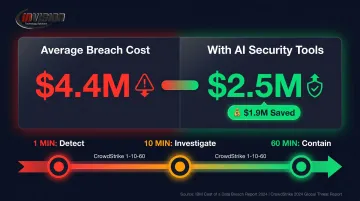
The CrowdStrike 1-10-60 benchmark frames the operational target: detect an intrusion within 1 minute, investigate within 10, contain within 60. Few firms consistently meet it — but those that don't face compounding consequences in financial services specifically, where breach detection delays directly trigger regulatory disclosure timelines.
IBM's 2025 Cost of a Data Breach report puts the global average breach cost at $4.4 million, with organizations using extensive AI security tools saving an average of $1.9 million compared to those that don't. At those numbers, speed and automation pay for themselves. Firms want real-time assurance that defenses are working — not annual penetration test reports that confirm yesterday's posture.
Cloud Security and Infrastructure Modernization: Risk Reduction, Not Just Innovation
According to PwC's Global Digital Trust Insights 2026 survey of nearly 4,000 business and technology executives, 34% list cloud security as a top investment priority — making it one of the two leading categories alongside AI-enabled security.
The motivation isn't cost savings. It's closing visibility gaps that legacy infrastructure simply cannot address.
The Problem with On-Premises Systems
Aging, siloed infrastructure creates specific security liabilities for financial firms:
- Limited visibility across distributed environments — threats can move laterally undetected
- Slower breach detection due to fragmented log management and manual correlation
- No built-in compliance controls — every audit requires manual evidence assembly
- Difficulty scaling security coverage for remote or hybrid workforces
Threat actors know exactly where these gaps are — and financial firms are high-value targets precisely because the gaps are predictable.
What Cloud Security Investment Looks Like
Firms aren't simply moving workloads to the cloud. They're rebuilding security architecture around it:
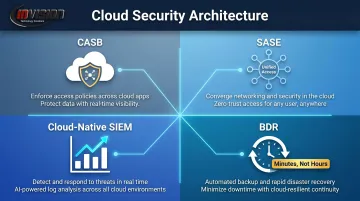
- Cloud Access Security Brokers (CASB) — controlling data access and enforcing policy across cloud applications
- Secure Access Service Edge (SASE) — unifying network access and security for distributed teams
- Cloud-native SIEM — replacing legacy log management with real-time, scalable analytics
- Backup and disaster recovery (BDR) — treated as a core security control with tested, documented recovery procedures
Rapid, tested recovery capability is now a regulatory expectation as much as an operational one. For financial firms subject to disclosure timelines, the ability to restore systems and demonstrate continuity directly affects how a breach is characterized to regulators. InVision Technology Solutions serves accounting and financial firms across the Phoenix Metro area, and its BDR practice — built on Veeam and Barracuda partnerships — is structured around one outcome: getting firms operational within minutes, not hours.
Compliance Technology and Regulatory Readiness: From Checkbox to Core Budget
The regulatory environment has changed in ways that make compliance spending non-negotiable for financial firms.
Three rules are doing most of the forcing:
- SEC cybersecurity disclosure rule — requires public companies to disclose material cyber incidents within 4 business days; Reg S-P amendments require customer notification within 30 days, with a compliance date of June 3, 2026
- NYDFS Part 500 — expanded requirements following 2023 amendments, with strengthened MFA and governance obligations
- FINRA 2025 Regulatory Oversight Report — elevates cybersecurity, AI risk, and third-party vendor oversight as critical priorities for broker-dealers
Enforcement is already active across all three frameworks — firms treating these as future problems are running out of runway.
What Compliance-Driven IT Spend Looks Like in 2026
The contrast with legacy compliance approaches is stark:
| Legacy Approach | 2026 Approach |
|---|---|
| Annual audits with manual evidence assembly | Continuous compliance monitoring with automated evidence collection |
| Spreadsheet-based policy documentation | Centralized policy management platforms |
| Reactive breach notification | Pre-built incident response playbooks mapped to 4-day disclosure clocks |
| Point-in-time control testing | Continuous control benchmarking against regulatory frameworks |
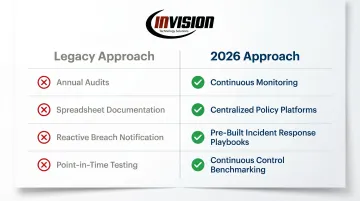
Many mid-market financial firms still operate closer to the left column. That gap creates both regulatory and reputational risk.
That gap becomes especially costly when a breach occurs. Firms operating on manual processes cannot quickly determine whether an incident is "material" under SEC definitions — forcing a choice between disclosing prematurely or risking late-disclosure penalties. Automated monitoring shortens that determination window from days to hours.
InVision Technology Solutions supports financial services clients across SOX, PCI DSS, and GLB compliance frameworks, providing continuous monitoring and documented audit trails that reduce the manual burden of evidence collection when regulators come calling.
What Else Is Getting Budget: Identity, Network Security, and Managed Services
Identity and Access Management (IAM)
Compromised credentials remain the most common initial attack vector in financial services breaches. IAM investment reflects that reality directly.
Financial firms are deploying:
- Multi-factor authentication (MFA) hardening across all user-facing systems
- Privileged access management (PAM) for administrator and high-risk account controls
- Zero trust network access (ZTNA) — verifying identity continuously, not just at the perimeter
- Role-based access control aligned to compliance documentation requirements
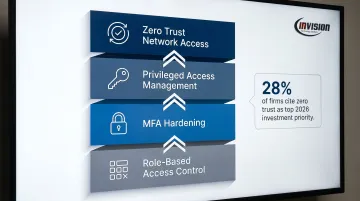
PwC's 2026 survey shows network security and zero trust cited by 28% of respondents as a top investment priority — and IAM sits at the core of most zero trust implementations.
Network Security
Distributed workforces and hybrid cloud environments have made perimeter-focused network security insufficient on its own. For many mid-market financial firms, IAM and network security investments are converging into unified SASE architectures that address remote access, cloud connectivity, and perimeter protection through a single platform — reducing tool sprawl while maintaining coverage.
Managed Security Services
That convergence of tools helps, but staffing remains the harder problem. 33% of security leaders report they cannot adequately staff their security teams, and 29% say they cannot afford the skills they need, according to ISC2's 2025 Cybersecurity Workforce Study. Building a 24/7 in-house SOC requires headcount, tooling, and expertise that most mid-market firms simply cannot sustain.
PwC's 2026 survey shows 21% of organizations list cyber managed services as a top investment priority — and usage is higher among firms that have recently experienced a significant incident.
For mid-market financial firms in the Phoenix Metro area, providers like InVision Technology Solutions offer a practical alternative to enterprise-level internal staffing. InVision's InWatch 24/7 monitoring system covers servers, desktops, laptops, and network devices continuously — backed by Cisco Security Specialized certification and Microsoft Partner credentials.
The firm's average response time of under 5 minutes and documented 245,765 threats blocked reflect active, around-the-clock protection rather than passive alerting.
Firms using managed or co-managed security models consistently demonstrate faster detection, more frequent testing, and better compliance documentation than comparably sized firms running security entirely in-house.
What's Driving These Decisions — and What to Watch Next
Four forces are reshaping how financial firms allocate security budgets:
- Accelerating threats — ransomware, social engineering, and third-party compromise are increasing in volume and sophistication; 45% of financial services organizations faced an AI-powered cyberattack in the past 12 months
- Tighter regulatory enforcement — SEC, NYDFS, and FINRA requirements compress response timelines and expand board accountability
- Persistent talent gaps — the global cybersecurity workforce shortage is pushing spend toward automation and managed services
- Board-level pressure — executives are now required to demonstrate measurable security outcomes, not just security postures
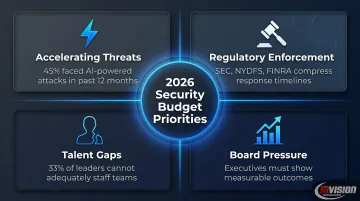
Together, these pressures are forcing a harder look at how security dollars are actually spent.
The Budget Efficiency Imperative
Total cybersecurity spend is rising, but growth rates have moderated since the post-pandemic surge. Firms are being asked to show ROI from existing investments, not just spend more. This is driving:
- Tool consolidation — 47% of organizations are actively reducing vendor overlap to close capability gaps and cut redundancy (PwC 2026)
- Integrated platforms over point solutions — consolidating tools lowers management complexity without sacrificing protection
- Automation — replacing manual security processes with continuous monitoring and automated response
Forward-Looking Signals for 2026–2028
- AI-assisted threat detection will shift from optional to standard — the $1.9M average savings from AI security use makes the business case difficult to ignore
- Third-party vendor risk management programs will become mandatory rather than best-practice, driven by SEC Reg S-P amendments and FINRA oversight
- Security-as-a-Service models will replace outright tool ownership for many mid-market firms, shifting security from a capital expense to a predictable operational one
Firms that act early on cloud readiness, automated compliance tooling, and managed security partnerships will be in a far stronger position to handle the next wave of regulatory changes — without scrambling to catch up.
Frequently Asked Questions
What percentage of IT budget do financial firms spend on cybersecurity?
Deloitte's 2023 financial services study shows approximately 10.9% of IT budgets and 0.48% of revenue allocated to cybersecurity — among the highest of any sector. For 2026 planning, a 10–12% share is a realistic baseline, with higher allocations justified by regulatory scope and threat exposure.
What are the 80/20, 90/10, and 1-10-60 rules in cybersecurity?
The 80/20 rule applies the Pareto principle: focus resources on the 20% of vulnerabilities driving 80% of risk. The 1-10-60 rule (from CrowdStrike) sets operational targets — detect in 1 minute, investigate in 10, contain in 60 — directly relevant to SEC disclosure timelines. The "90/10 rule" has no standardized authoritative definition; treat it cautiously unless tied to a named framework.
What compliance regulations are most impacting IT security budgets for financial firms in 2026?
The primary drivers are the SEC cybersecurity disclosure rule (4-day material incident reporting), NYDFS Part 500 (expanded MFA and governance requirements), and FINRA cybersecurity oversight (elevated third-party and vendor risk expectations). Each is pushing investment in automated evidence collection, incident response capability, and continuous monitoring over periodic audits.
Should financial firms build an in-house security team or outsource to an MSSP?
Most mid-market firms achieve stronger outcomes through managed or co-managed arrangements. Building a true 24/7 in-house SOC rarely pencils out at that scale — MSSPs provide certified expertise, faster incident response, and compliance documentation at comparable or lower cost.
How can mid-market financial firms prioritize IT security spending with limited budgets?
Start with the highest-impact risk areas: threat detection, access controls, and compliance automation. Consolidating tools into integrated platforms reduces cost and operational complexity without sacrificing coverage — and managed services can extend that coverage without adding headcount.
What is the biggest cybersecurity threat facing financial services firms in 2026?
Ransomware, phishing-based credential theft, and third-party vendor compromise are the top vectors. The financial impact goes further than direct losses — regulatory fines, mandatory client notifications, client attrition, and reputational damage all compound the initial breach cost, making prevention and rapid detection investments directly tied to business continuity.