The problem is that IT strategic planning consulting costs vary so widely that most businesses struggle to evaluate what they're actually buying. A $1,500 engagement and a $15,000 engagement can both be called "IT strategic planning" while delivering completely different outcomes.
This article breaks down 2026 pricing ranges by engagement type, explains the factors that drive cost up or down, and helps you size the right investment for your business.
Key Takeaways
- One-time IT strategic assessments typically run $1,500–$5,000
- Ongoing vCIO advisory retainers range from $1,500–$8,000+ per month
- The biggest cost drivers: engagement scope, business size, compliance requirements, and consultant seniority
- Small businesses benefit most from structured one-time assessments; mid-size and regulated-industry firms need ongoing advisory
- Spending more makes sense when scaling, facing compliance pressure, or recovering from repeated IT failures
How Much Does IT Strategic Planning Consulting Cost in 2026?
IT strategic planning consulting isn't priced like break-fix support or help desk coverage. You're not paying for hours of labor at a fixed rate — you're paying for a defined outcome, whether that's a documented technology roadmap, ongoing strategic alignment, or a full transformation plan.
That distinction matters because it makes direct price comparisons misleading without context. Two firms quoting vastly different numbers may be scoping entirely different engagements.
Typical Cost Ranges by Engagement Type
Entry-Level — One-Time IT Strategic Assessment
Best suited for businesses under 30 users that need clarity before committing to a technology direction. A structured assessment typically includes:
- Current-state infrastructure audit
- Gap analysis against business goals
- 12-month priority roadmap with recommended next steps
Typical cost: $1,500–$5,000 as a fixed-fee project, depending on environment complexity. This engagement does not include ongoing advisory, quarterly check-ins, or implementation oversight — it's a snapshot and a plan.
Mid-Range — Ongoing vCIO or Strategic Advisory Retainer
For businesses in the 25–150 user range that need continuous alignment between technology decisions and business direction. According to Scopable's 2026 MSP pricing analysis, most vCIO retainers run:
- $1,500–$3,000/month for small businesses (10–50 users)
- $3,000–$8,000/month for mid-market firms (50–200 users)
This tier typically covers quarterly planning sessions, technology roadmap management, budget forecasting, and vendor alignment. Cost within this range depends primarily on user count and compliance complexity.
High-End — Full Technology Transformation Planning
Larger organizations tackling cloud migrations, multi-site overhauls, or full system modernization typically work under a project-priced model rather than a retainer — scope and duration are defined upfront. Expect:
- $75,000–$300,000 for growing SMBs with multi-system change requirements
- $150,000–$1.5 million for mid-market transformations involving data integration and adoption programs
At this tier, you're engaging a team — not a single advisor — and the deliverable is a comprehensive transformation plan with phased implementation oversight.
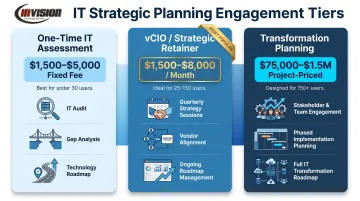
| Engagement Type | Best For | Typical Cost |
|---|---|---|
| One-Time IT Assessment | <30 users, one-time clarity | $1,500–$5,000 (fixed fee) |
| vCIO / Strategic Retainer | 25–150 users, ongoing alignment | $1,500–$8,000/month |
| Transformation Planning | 150+ users, major system changes | $75,000–$1.5M (project-priced) |
Key Factors That Affect IT Strategic Planning Consulting Costs
Pricing is shaped by engagement design, organizational complexity, and the expertise required. Understanding these variables helps you evaluate quotes accurately rather than just comparing dollar figures.
Scope and Duration
One-time assessments are project-priced with a defined end date. Retainers are monthly and open-ended. The counterintuitive reality: retainers often cost more in total over a year but significantly less per decision made. That's because the advisor stays aligned with your business as it changes, rather than working from a point-in-time snapshot.
Business Size and Environment Complexity
A 20-person professional services firm has a predictable IT footprint. A 150-person manufacturer with multiple sites, legacy systems, and OT/IT overlap is a fundamentally different planning challenge. Research from Cohesis shows a 30-person firm typically completes a technology roadmap in 4–5 weeks, while a 150-person manufacturer may require 8–10 weeks — directly affecting project cost.
Industry and Compliance Requirements
Regulated industries require IT strategic plans that address compliance frameworks, data governance, and audit documentation. That specialized expertise carries a premium:
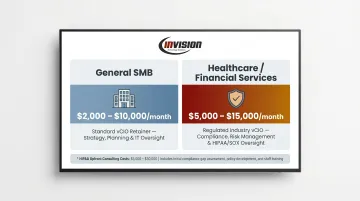
| Industry | Typical vCIO Monthly Retainer Range |
|---|---|
| General SMB | $2,000–$10,000/month |
| Healthcare / Financial Services | $5,000–$15,000/month |
Healthcare clients in particular face HIPAA compliance costs that can run $5,000–$30,000 upfront for consulting-led approaches, on top of ongoing advisory fees. For Phoenix Metro businesses in healthcare, dental, legal, or financial services, compliance planning is built into the strategic plan from day one — not treated as an afterthought. InVision Technology Solutions has worked with these industries for nearly two decades and structures IT roadmaps accordingly.
Consultant Seniority and Firm Type
The price gap between a solo consultant and a dedicated advisory firm is significant:
| Firm Type | Hourly Rate Range |
|---|---|
| Freelance / solo IT consultant | $50–$150/hour |
| Mid-size consulting firm / MSP vCIO | $100–$300/hour |
| Large enterprise advisory firm | $200–$500/hour |
For most SMBs, an MSP with dedicated vCIO capabilities offers the best balance of strategic depth and cost — with the added benefit that the same firm handling day-to-day support already understands your environment.
Deliverables Expected
Price scales with output. Before comparing quotes, confirm exactly what format the deliverable takes and whether it includes implementation guidance or just the plan itself. Common deliverable formats include:
- Verbal strategy session with no documentation
- Written summary with high-level recommendations
- Fully documented multi-year roadmap with phased timelines
- Comprehensive plan with budget forecasts and vendor recommendations
- Implementation-ready roadmap with ongoing advisory support
What's Included in IT Strategic Planning Consulting Fees
The consulting fee rarely covers everything. Businesses that budget only for advisory hours routinely encounter costs they didn't anticipate.
Initial IT Assessment and Discovery
Every strategic engagement starts here. A thorough discovery includes an audit of current systems and infrastructure, a security posture review, and alignment checks between existing technology and business goals. Some firms charge for this separately as a fixed-fee project; others roll it into the first month of a retainer.
Any complete assessment should cover four pillars: infrastructure, development, security, and data. If a proposed scope skips one of these, the resulting roadmap will have blind spots.
Technology Roadmap and Documentation
The roadmap is the primary deliverable. A completed roadmap includes prioritized initiatives, timelines, budget estimates by initiative, and vendor recommendations. Quality varies across price tiers:
- Lower-cost engagements produce a priority list with general guidance
- Higher-cost engagements produce a phased plan with measurable milestones, cost modeling, and risk-ranked initiatives
In ongoing retainers, the roadmap is typically refreshed annually with lightweight quarterly updates.
Ongoing Advisory and vCIO Sessions
Recurring advisory sessions are the component most consistently underestimated in budget planning — and the one that pays off most over time. A typical retainer covers:
- Technology decision support as new needs arise
- Evaluation of new tools and platforms
- Vendor negotiations and contract reviews
- Plan adjustments as the business grows or shifts
Implementation Oversight and Vendor Management
Implementation oversight — covering cloud migrations, software rollouts, and hardware refresh cycles — is frequently scoped and billed as a premium add-on. Businesses that don't budget for it often find their roadmap stays on the shelf because no one is accountable for execution.
Lower-Cost vs. Higher-Cost IT Strategic Planning: What's the Difference?
The gap between a $2,000 engagement and a $10,000+ one isn't primarily about hours — it's about depth, accountability, and whether the strategy actually gets executed.
| Dimension | Lower-Cost Engagement | Higher-Cost Engagement |
|---|---|---|
| Depth of assessment | Questionnaire or brief interview | Infrastructure review, stakeholder interviews, documented gap analysis |
| Roadmap quality | High-level priority list | Phased plan with timelines, budgets, and measurable outcomes |
| Accountability | One-time deliverable, no follow-through | Quarterly check-ins, plan updates, advisory access |
| Compliance coverage | Generic guidance | Framework-specific documentation and audit preparation |
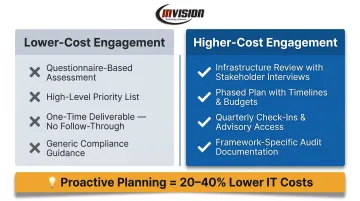
Those differences have real financial consequences. Businesses that plan proactively see up to 20–40% lower IT costs compared to reactive approaches — and the exposure on the other side is significant. For a 20-employee firm generating $5M in annual revenue, a single significant downtime event costs roughly $3,362 per hour. A full year of vCIO advisory costs less than two days of unplanned downtime.
How to Estimate the Right IT Strategic Planning Budget
The right budget is determined by what your business needs the plan to accomplish — not by finding the lowest quote.
Start by evaluating these four factors:
- Current IT state — Is your environment chaotic and reactive, or structured with documented systems? Chaotic environments need more discovery time and cost more to assess accurately.
- Growth trajectory — Rapid hiring, new locations, or new service lines all require proactive technology alignment. If you're scaling, a one-time assessment becomes outdated fast.
- Compliance exposure — Healthcare, dental, legal, and financial services firms in Phoenix Metro face regulatory requirements that must be addressed in any credible IT plan. Budget accordingly.
- One-time vs. ongoing need — If your environment is stable and well-documented, a structured one-time assessment may be sufficient. If you're making technology decisions quarterly, ongoing advisory pays for itself.
Once you've mapped those factors to your situation, it's equally important to know where budgets go wrong.
Common budgeting mistakes to avoid:
- Focusing only on the consulting fee while ignoring implementation costs: roadmaps without execution budgets stall before anything gets built
- Choosing a firm based on hourly rate without evaluating deliverable quality or accountability structure
- Expecting strategic planning outcomes from a break-fix or basic managed services contract
InVision Technology Solutions builds IT strategic planning into its managed services framework for Phoenix Metro businesses, with upfront pricing and no long-term contract required. If senior-level guidance without a locked-in commitment matters to your organization, it's a practical model to ask providers about directly.
Frequently Asked Questions
What is the average cost of IT strategic planning consulting for mid-size companies?
Mid-size businesses (roughly 50–150 users) typically pay $3,000–$8,000 per month for ongoing vCIO advisory. Regulated industries like healthcare and financial services generally fall toward the higher end of that range due to compliance complexity.
What is the difference between IT strategic planning consulting and managed IT services?
Managed IT services handle day-to-day support, monitoring, and maintenance. IT strategic planning focuses on the multi-year technology roadmap, business alignment, and decision-making framework. Many MSPs offer both, sometimes bundled together under higher-tier service plans.
What deliverables should I expect from an IT strategic planning engagement?
Standard outputs include a current-state assessment, a prioritized technology roadmap with timelines and budget estimates, and vendor recommendations. Ongoing engagements add quarterly plan updates and ongoing advisory access.
How long does an IT strategic planning engagement typically take?
A one-time assessment and roadmap delivery typically takes 4–8 weeks depending on environment size. Ongoing retainer engagements run indefinitely, with quarterly check-ins and annual full-plan refresh cycles.
Is IT strategic planning consulting worth it for small businesses?
Small businesses often benefit the most from a structured one-time assessment — it stops costly reactive decisions before they start. Even a basic roadmap can prevent misaligned technology purchases that cost far more than the consulting fee.
How often should a business update its IT strategic plan?
Plan for a full review annually, with lightweight quarterly check-ins in between. Major business events — rapid hiring, new locations, compliance audits — should trigger an unscheduled review whenever they occur.