Costs vary more than most owners expect. A solo operator can get a solid cloud VoIP line for under $20/month, while a 20-person office with CRM integrations and call recording might pay $50+ per user. That gap causes two predictable problems: overpaying for enterprise features a small team will never use, or buying the cheapest plan and discovering it's missing auto-attendant, call recording, or compliance tools.
This guide breaks down 2026 VoIP pricing tiers, every cost component, the factors that move the number up or down, and the hidden costs most small businesses miss entirely.
Key Takeaways
- Typical range: $15–$50/user/month depending on features and provider tier
- User count, required features, hardware, and contract length drive the biggest cost differences
- Cloud-only setups cost the least — on-premise PBX requires $7,000–$14,500+ upfront for 10–20 users
- Annual billing saves 15–50% over monthly rates — factor in early termination penalties before committing
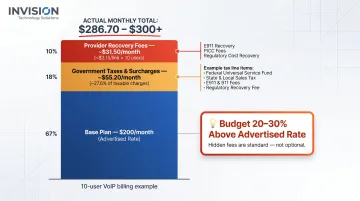
- Budget 20–30% above the advertised rate once taxes, regulatory fees, and add-ons are included
How Much Do VoIP Services Cost for Small Businesses in 2026?
VoIP pricing doesn't follow a single rate card. Two businesses with the same headcount can pay very different amounts depending on which features they need, whether they commit annually, and how carefully they read the plan details before signing.
The two most common budget mistakes:
- Choosing the cheapest plan without checking what's excluded (auto-attendant, call recording, and CRM integrations are often locked behind higher tiers)
- Buying an enterprise-tier plan that looks comprehensive on paper — most 10-person offices have no use for unlimited international calling to 48 countries or AI contact center features
The three standard tiers in 2026 break down as follows.
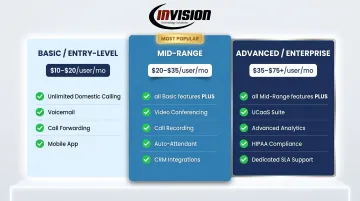
Basic / Entry-Level Plans: $10–$20/User/Month
Included: Unlimited domestic calling, basic voicemail, call forwarding, mobile and desktop app access, and one phone number per user.
| Provider | Plan | Annual Price |
|---|---|---|
| Zoom Phone | US & Canada Unlimited | $15/user/mo |
| Vonage Business | Mobile | $13.99/user/mo |
| Nextiva | Core | $15/user/mo |
| Dialpad | Standard | $15/user/mo |
| RingCentral | Core | $20/user/mo |
Best for: Solo operators, micro-businesses (1–5 users), and anyone replacing a basic landline who doesn't need integrations or analytics.
Mid-Range Plans: $20–$35/User/Month
Adds: Video conferencing, call recording, voicemail transcription, auto-attendant/IVR, and CRM integrations — on top of everything in the entry tier.
| Provider | Plan | Annual Price |
|---|---|---|
| Vonage Business | Premium | $20.99/user/mo |
| 8x8 | X2 | $24/user/mo |
| RingCentral | Advanced | $25/user/mo |
| Dialpad | Pro | $25/user/mo |
| Vonage Business | Advanced | $27.99/user/mo |
Best for: Small businesses with 5–25 employees that need professional call handling, remote or hybrid staff, and integration with tools like Microsoft 365 or a CRM.
Advanced / Enterprise Plans: $35–$75+/User/Month
Included: Full UCaaS suite (voice, video, messaging), advanced analytics, API access, HIPAA-ready compliance configurations, and dedicated support with SLA-backed uptime.
| Provider | Plan | Annual Price |
|---|---|---|
| RingCentral | Ultra | $35/user/mo |
| 8x8 | X4 | $44/user/mo |
| Nextiva | Scale | $75/user/mo |
Best for: Businesses in regulated industries — healthcare, legal, finance — or those with 25+ users requiring custom call flows, compliance documentation, and guaranteed uptime.
Key Factors That Affect VoIP Costs for Small Businesses
Behind every VoIP quote are five variables. Understanding each one helps you read a proposal critically and avoid paying for things you don't need.
Number of Users and Lines
Per-user pricing is the standard model. Small teams typically pay the full listed rate; larger teams may qualify for volume discounts. Worth noting: some businesses need more lines than users. A reception desk handling multiple simultaneous calls may need 3–4 lines for 1–2 staff members, which affects total cost even though headcount stays the same.
Feature Set and Plan Tier
Many features that seem standard are actually gated or sold separately. Common examples:
- Call recording: Often $5–$10/user/month as an add-on, or only included at the Advanced tier
- CRM integrations (Salesforce, HubSpot): Typically requires mid-tier or higher; can add $10–$25/user/month
- AI call summaries: $15–$25/user/month — emerging feature still mostly premium-only
RingCentral's pricing page lists standalone add-ons: AI Receptionist starting at $39/month, Business SMS Booster at $25/month, and AI Conversation Expert starting at $60/month.
Deployment Type: Cloud vs. On-Premise
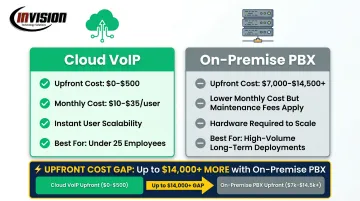
| Criteria | Cloud VoIP | On-Premise PBX |
|---|---|---|
| Upfront cost (10 users) | $0–$500 | $7,000–$14,500+ |
| Monthly cost | $10–$35/user | Lower, but maintenance adds up |
| Scalability | Add users instantly | Requires hardware changes |
| Best for | Under 25 employees | High-volume, long-term deployments |
For most small businesses under 25 employees, cloud VoIP is the clear choice. The capital expense of on-premise PBX is hard to justify: Tech.co estimates $6,500 in hardware, $3,000 in phones, and $4,000 in software licenses for 20 users alone.
Hardware Requirements
Cloud VoIP runs on existing computers and smartphones — no hardware cost required. If you want dedicated IP desk phones:
- Entry-level IP phones (Yealink T33G, Poly VVX 250): $60–$83 per device
- High-end video-capable phones (Yealink VP59): $850–$943
- Wired headsets (Jabra Evolve 20): ~$36–$50
- Premium wireless headsets: $400+
Some providers offer hardware leasing programs — monthly payments instead of a lump-sum purchase — if you'd rather preserve cash flow.
Contract Length and Payment Cycle
Annual billing discounts are significant:
- Nextiva: Up to 50% savings annually vs. monthly (Core: $15/user vs. $23/user)
- RingCentral: ~33% savings (Core: $20/user vs. $30/user)
- Dialpad: ~35% savings (Standard: $15/user vs. $23/user)
The trade-off: annual contracts carry early termination penalties. Both RingCentral and Nextiva charge remaining-balance fees if you cancel before the term ends. If your team is still growing or your needs aren't settled, paying more month-to-month buys you flexibility worth having.
Full VoIP Cost Breakdown: One-Time vs. Recurring Expenses
The advertised per-user rate is a starting point — not the total. Before you sign anything, here's every cost category that shows up on a real VoIP invoice.
One-Time Costs
| Item | Typical Cost |
|---|---|
| 10DLC brand registration (for business SMS) | ~$4 |
| 10DLC campaign registration | $15–$17 |
| Number porting (keeping existing number) | Free (Nextiva) to $39.99 (Ooma) |
| Vanity phone numbers | ~$30/number (RingCentral) |
| IP desk phones (per device) | $60–$943 depending on model |
| Provider setup/activation fees | Varies; many cloud providers waive this |
Recurring Monthly Costs
| Item | Typical Cost |
|---|---|
| Base subscription | $10–$75/user/month |
| Additional DID phone numbers | $4.99–$9.99/number/month |
| Call recording add-on | $5–$10/user/month |
| Toll-free numbers | $5–$15/month per number |
| 10DLC monthly campaign fee | $1.50–$10/month |
| International calling | From $0.01/min for select countries |
Internet and Network Infrastructure
The FCC classifies VoIP calls as requiring less than 0.5 Mbps download speed. Each call uses roughly 80–100 kbps per direction — meaning a 10-person office with all users on simultaneous calls needs only about 1 Mbps dedicated to voice. Most Phoenix Metro business connections clear that threshold easily.
Raw bandwidth rarely causes VoIP problems. The real culprits are network quality issues:
- Jitter — inconsistent packet arrival that creates choppy audio
- Latency — delays above 150ms that make conversations feel laggy
- Packet loss — dropped data that causes clipping or dropped words
If call quality is poor, a QoS-enabled router configuration (not a faster internet plan) usually resolves the problem.
Taxes, Regulatory Fees, and Surcharges
Most small businesses don't see this coming until the first invoice. According to the Tax Foundation's 2024 wireless tax study, taxes, fees, and government surcharges averaged 26.8% of taxable voice service costs — up 8.8% from the prior year. The 2025 figure has risen further to 27.6%.
On top of government taxes, providers add their own recovery fees:
- RingCentral: ~$3.00/seat/month compliance and administrative fee
- Nextiva: ~$3.25/line/month regulatory recovery fee + ~$1.00/line/month E911 charge
For a 10-user office on a $20/user/month plan: the $200 advertised monthly cost can realistically land at $260–$300 after taxes and provider surcharges.
Hidden Costs Most Small Businesses Overlook
Cancellation Fees and Auto-Renewal Traps
Contract terms are where VoIP costs can quietly balloon. RingCentral requires 30 days' notice to cancel and charges the remaining contract balance as an early termination fee. Nextiva enforces similar policies on annual contracts. Before signing anything, check the contract for:
- Early termination fee structure (remaining balance vs. flat fee)
- Auto-renewal terms and notice windows
- Whether month-to-month is available at a premium
Add-On Creep
Cancellation terms are just one trap — base pricing is another. Low advertised prices often serve as entry points for à la carte charges on features most businesses expect to be included. Features commonly excluded from base plans:
- Auto-attendant / IVR
- Call recording and storage
- Voicemail transcription
- CRM integrations
- Additional phone numbers beyond one per user
These add-ons can easily double a $15/user base plan before you've enabled a single advanced feature.
Tiered Pricing Escalation During Growth
Add-on costs compound further when your team grows. Some providers require a full plan upgrade once headcount exceeds a threshold — and that upgrade applies to all users, not just the new ones. Ask every provider directly: How does pricing change as I add users? If the answer is vague, request it in writing before committing.
VoIP vs. Traditional Phone Systems: How the Costs Really Compare
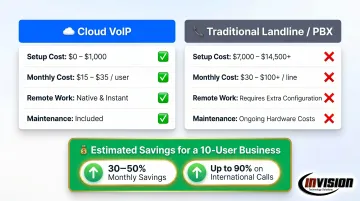
For a 10-user small business:
| Cloud VoIP | Traditional Landline / On-Premise PBX | |
|---|---|---|
| Setup cost | $0–$1,000 | $7,000–$14,500+ |
| Monthly per-user cost | $15–$35 | $30–$60/line (or $100+ with fees) |
| Maintenance cost | Included or minimal | Ongoing hardware and support contracts |
| Scaling cost | Add users via dashboard | Physical wiring and hardware changes |
| Remote work support | Native | Requires additional configuration |
Businesses switching from traditional landlines to VoIP typically save 30–50% on monthly communication costs, with international calling savings reaching up to 90%. Factor in setup costs, and the gap widens further: a $14,500 PBX installation versus near-zero for cloud VoIP is a substantial difference for any small business managing cash flow.
Cost savings aside, compliance and uptime carry equal weight for Phoenix Metro businesses in healthcare and legal. Cloud VoIP's built-in redundancy and disaster recovery address HIPAA requirements and continuity needs that traditional PBX systems simply can't match at comparable cost.
How to Budget for VoIP the Right Way
A 4-Step Budgeting Process
- Audit your current phone bill — document every line, feature, and fee you're paying today. This establishes your baseline and reveals what you're actually using.
- List must-haves vs. nice-to-haves — separate features you can't operate without (auto-attendant, call recording for compliance) from those that sound useful but aren't critical yet.
- Calculate true per-user cost for 2–3 providers — include base subscription, add-ons you actually need, regulatory fees (~$4–$5/user), and taxes (~27% of taxable charges).
- Factor in one-time costs — hardware (if any), number porting, and 10DLC registration for business texting.
Questions to Ask Every Provider Before Signing
- What's included in the base plan vs. charged as add-ons?
- How does pricing change as I add users — do rates go up or down?
- What are the exact contract terms, auto-renewal window, and early termination fee?
- Does the provider offer local or dedicated support, or is it a national call center?
For Phoenix Metro businesses juggling phones, Microsoft 365, network, and security under one roof, a local managed IT provider simplifies the whole process. InVision Technology Solutions in Scottsdale assesses your existing network infrastructure, determines whether a QoS configuration or bandwidth upgrade is needed, and recommends the right VoIP tier based on actual call volume data. They support both Cisco and Switchvox (Sangoma) systems, with upfront, transparent pricing and no pressure to overbuy.
Conclusion
VoIP costs for small businesses in 2026 range from $10–$15/user/month for basic cloud plans to $75+/user/month for enterprise-grade compliance and analytics. The right plan matches your team size, industry requirements, and the features you'll realistically use — not just the lowest advertised price.
The full picture always includes more than the advertised rate: hardware, taxes, regulatory fees, and potential add-ons can push your actual monthly bill 20–30% above what the plan page shows. Understanding that gap before you sign leads to better budgeting and fewer surprises. For Phoenix Metro businesses in healthcare, legal, or accounting — where compliance requirements directly affect which VoIP features you need — working with a local IT partner before selecting a platform can prevent costly mid-contract adjustments. InVision Technology Solutions helps businesses in these industries assess VoIP options and implement systems that fit both their budget and their compliance obligations.
Frequently Asked Questions
How much does a VoIP phone system cost for a small business in 2026?
Most small businesses pay $15–$35/user/month on annual billing, with basic plans starting around $10–$15 and advanced tiers reaching $50–$75+. Hardware and 10DLC registration are typically extra. For a 10-person team, annual costs commonly land between $2,400 and $6,000 depending on features.
Is VoIP cheaper than a traditional landline for small businesses?
Yes — traditional business landlines run $30–$60/line/month (often $100+ with all fees), plus $7,000–$14,500 in setup costs for an on-premise PBX. Businesses switching to VoIP typically save 30–50% on monthly costs, with near-zero upfront setup for cloud systems.
What are the hidden costs of VoIP services small businesses should watch for?
Watch for three recurring surprises: early termination fees (often the full remaining contract balance), add-on charges for features like call recording and auto-attendant not included in the base plan, and taxes plus regulatory recovery fees that tack 20–30% onto the advertised rate.
Does VoIP require a high-speed internet upgrade?
Rarely. The FCC classifies VoIP as requiring less than 0.5 Mbps per call — most business internet plans support 10+ concurrent calls easily. Call quality issues are usually caused by jitter or packet loss, which a QoS router configuration resolves without upgrading your internet speed.
What is the difference in cost between cloud VoIP and on-premise PBX?
Cloud VoIP requires little to no upfront investment and costs $10–$35/user/month. On-premise PBX requires $7,000–$14,500+ in hardware and installation for a 10–20 user system, with lower ongoing monthly fees. For most small businesses, cloud VoIP is the better financial fit unless you have 25+ users and a 5+ year planning horizon.
How do I choose the right VoIP plan for my small business without overpaying?
Start by auditing your actual call volume and listing only the features you need operationally. Then compare the true total cost across two or three providers: base plan plus add-ons, taxes, and regulatory fees. A local IT partner familiar with your infrastructure — like InVision Technology Solutions, which has helped Phoenix Metro businesses evaluate and deploy VoIP for nearly 20 years — can match the right system to your setup without recommending features you won't use.