Introduction
Financial firms — from solo CPAs in Scottsdale to mid-size investment advisors in Phoenix — sit at the intersection of two things every cybercriminal wants: money and sensitive personal data. That combination makes financial firms one of the most aggressively targeted industries on the planet.
The numbers reflect that reality. According to IBM's 2024 analysis, the average cost of a data breach in the financial industry hit $6.08 million — well above the $4.88 million global average across all sectors. Meanwhile, the Verizon 2025 Data Breach Investigations Report recorded 3,336 incidents and 927 confirmed breaches in finance and insurance alone.
This guide covers what financial services cybersecurity actually means, the threats that show up most often, the regulations that apply to your firm, and the practical steps you can take to protect your clients and your business — starting now.
Key Takeaways
- Financial services cybersecurity protects institutions, client data, and transactions from digital threats — covering banks, accounting firms, advisors, and insurers alike
- These firms are high-value targets because they hold Social Security numbers, credentials, payment data, and large sums of money
- The most common threats: phishing, ransomware, insider threats, DDoS attacks, and cloud misconfigurations
- Key regulations — GLBA, FTC Safeguards Rule, and PCI-DSS — require formal, documented security programs
- Small and mid-size firms can access strong, scalable security coverage by partnering with a managed IT provider
What Is Cybersecurity for Financial Services?
Financial services cybersecurity is the set of technologies, processes, and policies that protect financial institutions from unauthorized access, data breaches, fraud, and other digital threats. It applies to banks, credit unions, accounting firms, tax preparers, insurance companies, payment processors, investment advisors, and mortgage companies.
Three core principles anchor every security program:
- Confidentiality — keeping client data private and accessible only to authorized parties
- Integrity — ensuring financial records cannot be altered without detection
- Availability — keeping systems operational so clients and staff can access them when needed
Who This Applies To Beyond Big Banks
Many smaller financial businesses assume cybersecurity is a large-bank problem — it isn't. Accounting firms, CPA practices, financial advisors, and mortgage companies in the Phoenix Metro area hold the same categories of sensitive data — Social Security numbers, tax returns, account credentials, transaction histories — and face the same regulatory obligations as larger institutions.
Smaller firms typically have fewer dedicated security resources, which makes them easier targets. Attackers factor that gap directly into their targeting decisions.
Why Financial Firms Are Prime Targets
The Verizon 2025 Finance Snapshot found that breached data in the financial sector included:
- Personal data in 54% of breaches
- Internal data in 35% of breaches
- Credentials in 22% of breaches
Each new tool a financial firm adopts expands the attack surface. Online banking portals, cloud accounting platforms (QuickBooks Online, Lacerte, Sage), mobile payment apps, and third-party integrations all represent potential entry points — and every connection needs to be secured.
Common Cyber Threats Targeting Financial Firms — With Examples
Phishing and Business Email Compromise
Phishing uses fraudulent emails or messages to trick employees or clients into revealing credentials or transferring funds. Business Email Compromise (BEC) is the most financially damaging variation: an attacker impersonates a CFO, accountant, or vendor and requests an urgent wire transfer to a new account.
The scale of BEC losses is hard to overstate. The FBI's 2024 Internet Crime Report recorded 21,442 BEC complaints and $2.77 billion in adjusted losses in a single year. Over the prior decade, BEC caused more than $55 billion in global exposed losses.
Ransomware
Ransomware encrypts a firm's files and demands payment for their release. For an accounting firm, a ransomware attack during tax season — locking access to every client file days before a filing deadline — creates both operational chaos and regulatory exposure.
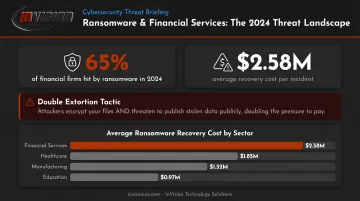
Smaller firms bear a disproportionate share of this risk. Sophos reported that 65% of financial services organizations with 100–5,000 employees were hit by ransomware in 2024, with average recovery costs reaching $2.58 million. Modern ransomware attackers also use double extortion — threatening to publish stolen data if the ransom isn't paid, compounding both reputational and regulatory exposure.
In 2025, the New York Attorney General announced a settlement with accounting firm Wojeski & Company after a ransomware attack exposed personal data — a concrete reminder that these incidents carry regulatory consequences.
Insider Threats
Insider threats involve current or former employees, contractors, or vendors who misuse their system access — either deliberately (stealing client data) or accidentally (clicking a malicious link). They're particularly difficult to detect because they operate with legitimate credentials.
Ponemon's 2023 research found that financial services organizations spent an average of $20.68 million annually to resolve insider threats. Notably, careless or negligent employees caused 55% of insider incidents — not malicious actors.
DDoS Attacks
DDoS attacks flood online banking portals, payment systems, or firm websites with traffic until they crash, denying access to legitimate users. Financial services received 35% of all DDoS attacks across industries in 2023, according to FS-ISAC and Akamai, with attacks on the sector up 154% year-over-year.
### DDoS Attacks
DDoS attacks flood online banking portals, payment systems, or firm websites with traffic until they crash, denying access to legitimate users. Financial services received 35% of all DDoS attacks across industries in 2023, according to FS-ISAC and Akamai, with attacks on the sector up 154% year-over-year.
Cloud and API Vulnerabilities
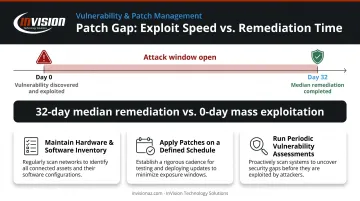
Cloud and API vulnerabilities present a distinct risk as financial firms shift to cloud-based platforms. A misconfigured storage bucket or unsecured API can expose thousands of client records with no active attack required. Vulnerability exploitation as an initial access vector increased 34% in the 2025 DBIR, with a median time to mass exploitation of zero days — attackers move the moment they find an opening.
Key Cybersecurity Regulations Financial Firms Must Know
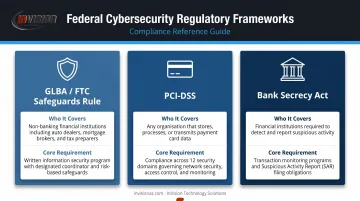
Three federal frameworks govern most financial services businesses operating in the US:
| Regulation | Who It Covers | Core Requirement |
|---|---|---|
| GLBA / FTC Safeguards Rule | Non-banking financial institutions (including accounting firms, tax preparers, mortgage companies) | Written information security program covering risk assessment, controls, training, and incident response |
| PCI-DSS | Any firm that stores, processes, or transmits payment card data | 12 security domains: network security, access control, encryption, and monitoring |
| Bank Secrecy Act (BSA) | Financial institutions required to file Suspicious Activity Reports | Monitor transactions and file Suspicious Activity Reports with FinCEN |
What Non-Compliance Actually Costs
Non-compliance isn't just a technical violation — it creates real legal and financial exposure:
- The FTC Safeguards Rule amendment (effective May 2024) requires firms to notify the FTC within 30 days of a breach affecting 500 or more consumers
- The FTC has enforced GLBA against mortgage companies for failure to protect customer data
- The OCC assessed an $80 million civil money penalty against Capital One for cloud risk management failures
Compliance is not the same as security. Meeting regulatory minimums reduces legal risk — but a firm that passes its annual audit can still fall to a phishing attack, unpatched software, or a misconfigured firewall. Real protection requires continuous monitoring, tested incident response plans, and controls that go beyond what auditors check.
Essential Cybersecurity Best Practices for Financial Services
Multi-Factor Authentication (MFA)
MFA requires users to verify their identity through two or more steps before accessing systems — a password plus a phone verification code, for example. CISA states that MFA makes accounts 99% less likely to be compromised.
Make MFA mandatory for all staff, especially anyone accessing client financial data, email, or cloud platforms. Given that credentials appeared in 22% of financial breaches in the 2025 DBIR, this is one of the highest-impact controls available.
Encryption and Role-Based Access Controls
Encryption converts data into an unreadable format — so even if an attacker intercepts files or a drive, they can't use the information. The FTC Safeguards Rule requires covered financial institutions to encrypt customer information in storage and transit.
Pair encryption with role-based access controls: employees should only be able to access data required for their specific job. A billing coordinator doesn't need access to every client record, and a junior advisor doesn't need admin-level system permissions.
Patching and Vulnerability Management
Outdated software is one of the most common attack entry points. Key practices:
- Maintain an up-to-date inventory of all hardware and software
- Apply patches on a defined, regular schedule (CISA's Known Exploited Vulnerabilities Catalog provides remediation timelines)
- Run periodic vulnerability assessments to identify gaps before attackers do
Median time to remediate edge-device vulnerabilities was 32 days in the 2025 DBIR. With mass exploitation occurring in zero days, a 32-day remediation window is enough time for attackers to do serious damage.
Security Awareness Training
Employees are the most frequent vulnerability in financial firms — not because they're careless, but because attackers specifically target them. Verizon's research found that users trained within the last 30 days reported phishing simulations at a 21% rate, compared to just 5% for those without recent training.
Effective training is role-specific: a finance clerk needs to know how to spot wire transfer fraud requests; an HR administrator needs to recognize credential-harvesting emails. Generic annual training rarely changes behavior.
24/7 Monitoring and Incident Response Planning
Continuous network monitoring catches anomalies — unusual login times, large data transfers, access from unrecognized devices — before they escalate. This is especially important for financial firms whose systems are targeted around the clock.
Monitoring only helps if there's a documented incident response plan attached to it. Every team member should know their role when a threat is detected: who gets notified, who has authority to isolate a system, who contacts clients, and who engages outside support.
If your firm doesn't have in-house security staff, a managed IT provider can fill that gap. InVision Technology Solutions' InWatch system delivers 24/7 monitoring across servers, desktops, laptops, and network devices for Phoenix Metro financial firms, with an average response time of five minutes.
How to Build a Cybersecurity Strategy for Your Financial Firm
Start With a Risk Assessment
Before buying tools, know what you're protecting. A risk assessment maps:
- What sensitive data your firm holds and where it lives
- Who can access it — and whether access is appropriately restricted
- Your biggest vulnerability points (outdated software, weak authentication, unmonitored third-party access)
The FTC Safeguards Rule actually requires this as a formal component of your written security program. The FFIEC Cybersecurity Assessment Tool and NIST Cybersecurity Framework both provide structured approaches for smaller financial firms.
InVision offers a free network security assessment for financial firms in the Phoenix Metro area — a practical starting point for understanding your current security posture.
Layer Your Defenses
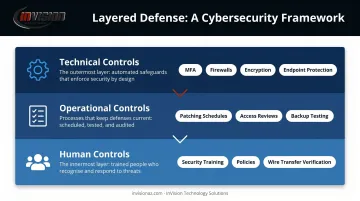
No single control protects against every threat. A strong financial services security strategy combines:
- Technical controls — MFA, firewalls, encryption, endpoint protection
- Operational controls — patching schedules, access reviews, backup testing
- Human controls — security training, clear policies, wire transfer verification procedures
Each layer compensates for the weaknesses of the others. An employee who gets phished still can't expose data if access controls and MFA are properly configured.
Partner With a Local Managed IT Provider
For small and mid-size financial businesses without a dedicated IT security team, managing security internally without a dedicated team isn't realistic. A managed IT provider fills that gap with certified expertise and continuous oversight.
InVision Technology Solutions serves accounting firms, CPAs, financial advisors, and other financial services businesses across the Phoenix Metro area. As a Cisco Security Specialized and Microsoft Silver Technology Partner, InVision brings enterprise-level security to firms of any size. Every client is assigned:
- Two dedicated engineers (primary and secondary systems administrator)
- A technical manager and account manager for ongoing coordination
The no-contract model means financial firms can scale services up or down as needs change, without long-term commitments. That flexibility is particularly useful for firms with seasonal fluctuations or shifting compliance requirements.
Frequently Asked Questions
What is financial cybersecurity?
Financial cybersecurity is the practice of protecting financial institutions and their clients — including banks, accounting firms, and investment advisors — from digital threats such as data breaches, fraud, and ransomware. It combines technology, security policies, and employee training into a coordinated defense.
What are the most common cyber attacks targeting financial institutions?
Phishing, ransomware, insider threats, DDoS attacks, and cloud/API vulnerabilities are the most frequently reported threats. Phishing and ransomware together account for the majority of financial sector breaches, with BEC attacks generating billions in annual losses.
What regulations govern cybersecurity in financial services?
The key federal frameworks are GLBA, the FTC Safeguards Rule, PCI-DSS, and the Bank Secrecy Act. Non-compliance can result in regulatory fines, legal liability, mandatory breach notifications, and reputational damage — often exceeding the cost of the security measures themselves.
What is multi-factor authentication and why does it matter for financial firms?
MFA requires users to verify their identity through multiple steps before accessing systems, which blocks attackers even when a password is compromised. CISA reports that MFA reduces account compromise risk by 99% — a strong return for one of the simplest controls to deploy.
How can small financial firms afford strong cybersecurity?
Smaller firms don't need an in-house security team to stay protected. Partnering with a managed IT services provider gives access to professional-grade monitoring, threat detection, and compliance support at a predictable monthly cost — typically far less than hiring a single full-time IT security employee.
What should I look for in a cybersecurity partner for my financial business?
Look for relevant certifications (such as Cisco Security or Microsoft Partner status), demonstrated experience with financial services clients, 24/7 monitoring capabilities, and transparent pricing with no long-term contract requirements. Providers based in your region will also have a clearer grasp of the specific regulatory environment you operate in.